
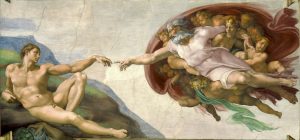
Click here for a PDF of this essay with added color coding.
June 2026 edition. Shared with permission. Headers and bolding added by Nate Richardson.
Richardson’s introductory note:
This essay helps to clarify doctrines about Adam, suggesting that Adam is a title used by both God, and the man who fell in Eden. It shows that Adam and Eve were made by their parents naturally, that God is not just our spiritual father, but is also our physical father. Luke 3:38, Moses , and other scriptures support this claim. The Father Adam referred to by Brigham Young and others was in fact God the Father, and the Adam who is Michael who fell in Eden is a separate person. Hebrew word analysis, comparative mythology, and teachings of various church leaders are used to support this claim.
These teachings of the literal natural fatherhood of God are in alignment with the 1909 First Presidency Statement “The Origin of Man” which stated:
“Inquiries arise from time to time respecting the attitude of The Church of Jesus Christ of Latter-day Saints upon questions which, though not vital from a doctrinal standpoint, are closely connected with the fundamental principles of salvation. The latest inquiry of this kind that has reached us is in relation to the origin of man. It is believed that a statement of the position held by the Church upon this subject will be timely and productive of good.
“In presenting the statement that follows we are not conscious of putting forth anything essentially new; neither is it our desire so to do. Truth is what we wish to present, and truth—eternal truth—is fundamentally old. A restatement of the original attitude of the Church relative to this matter is all that will be attempted here. To tell the truth as God has revealed it, and commend it to the acceptance of those who need to conform their opinions thereto, is the sole purpose of this presentation. …
…“It is held by some that Adam was not the first man upon this earth and that the original human being was a development from lower orders of the animal creation. These, however, are the theories of men. The word of the Lord declared that Adam was “the first man of all men” (Moses 1:34), and we are therefore in duty bound to regard him as the primal parent of our race. It was shown to the brother of Jared that all men were created in the beginning after the image of God; whether we take this to mean the spirit or the body, or both, it commits us to the same conclusion: Man began life as a human being, in the likeness of our Heavenly Father.
“True it is that the body of man enters upon its career as a tiny germ embryo, which becomes an infant, quickened at a certain stage by the spirit whose tabernacle it is, and the child, after being born, develops into a man. There is nothing in this, however, to indicate that the original man, the first of our race, began life as anything less than a man, or less than the human germ or embryo that becomes a man.
“Man, by searching, cannot find out God. Never, unaided, will he discover the truth about the beginning of human life. The Lord must reveal Himself or remain unrevealed; and the same is true of the facts relating to the origin of Adam’s race—God alone can reveal them. Some of these facts, however, are already known, and what has been made known it is our duty to receive and retain.
“The Church of Jesus Christ of Latter-day Saints, basing its belief on divine revelation, ancient and modern, proclaims man to be the direct and lineal offspring of Deity. God Himself is an exalted man, perfected, enthroned, and supreme. By His almighty power He organized the earth and all that it contains, from spirit and element, which exist coeternally with Himself. He formed every plant that grows and every animal that breathes, each after its own kind, spiritually and temporally—“that which is spiritual being in the likeness of that which is temporal, and that which is temporal in the likeness of that which is spiritual.” He made the tadpole and the ape, the lion and the elephant, but He did not make them in His own image, nor endow them with godlike reason and intelligence. Nevertheless, the whole animal creation will be perfected and perpetuated in the Hereafter, each class in its “distinct order or sphere,” and will enjoy “eternal felicity.” That fact has been made plain in this dispensation (see D&C 77:3).
“Man is the child of God, formed in the divine image and endowed with divine attributes, and even as the infant son of an earthly father and mother is capable in due time of becoming a man, so the undeveloped offspring of celestial parentage is capable, by experience through ages and aeons, of evolving into a God.
[End of 1909 The Origin of Man First Presidency Statement quotation.]
We will see further in this essay how indeed, mankind is the “direct and lineal offspring of Deity” (1909 Origin of Man). Get ready to ponder anew what the Almighty can do!
Much further treatment of this subject is available, but this essay serves to demonstrate a consistent understanding of scripture. It should be noted that a similar essays defending this perspective have been written by Elden Watson (perhaps the first to discover the ‘two Adams’ perspective in recent times), Alma Allred, and recently Jonah Barnes on Ward Radio has suggested the same concepts, and shows that altered punctuation in transcripts of Brigham’s speeches can provide different meanings etc. This article by Edwin Goble represents a significant amount of monumental new rigorous research on the subject, bringing it toward a much higher level of understanding and plausibility. I’m also working on a book expounding on the whole subject including surrounding doctrines and many quotations, contact me for further details or if you have insights to share on the topic.
Others such as Dr. Robert Wright hold that the creation of Adam from dust and Eve from the rib are to be understood on a non-symbolic level, and that perspective is also valid, and may turn out to be the correct position on every level. There are strong points to that perspective in addition to scriptural authority, such as the physical capacity of the rib to repair itself and the discovery of cloning technology.
What should certainly be rejected are the ideas that Adam is merely a myth (which idea is promoted by mainstream academia). The scriptures clearly teach chronologically and otherwise that about 6000 years ago, Adam and Eve were made, and that all human beings are descendants from them.
Now let us enjoy brother Goble’s writings which bring refreshing insights into the reality of Adam and Eve, and our shared identity with them as children of God, in the truest and most powerful sense:
Abstract:
This paper is written from the believing Latter-day Saint perspective. The Church of Jesus Christ of Latter-day Saints (historically nicknamed “Mormon”) is the religion that was established by Joseph Smith the Prophet. In the year 2018, the leader of the largest Latter-day Saint denomination, Russell M. Nelson, directed members to cease using the nickname, and refer to the Church by its legal name.
LDS Corporal God
The Latter-day Saint religion is unique in its belief that not only does Jesus have a body, but also the Father, being a separate individual in LDS belief, has a body. It is obvious where Jesus got his body, because he was born to Mary. Christian belief in general holds that Jesus’ conception was a miraculous event brought on by the third member of what LDS call the “Godhead,” and what other Christians generally call the Trinity. But in other Christian religions, the Trinity constitutes a mystery of three persons in one God, united in an unknown fashion. And somehow, a being that is a Spirit (without a body), had a Son, but this is a mystery not to be explained, just accepted. On the other hand, in the LDS religion, the three beings of the Godhead or Trinity form a council or quorum, and are united in purpose and will. So, for the LDS, it is natural that God the Father, having a body like any other human being, would have a Son with a body. But most LDS still hold that the conception of Jesus was brought about by the power of the Holy Ghost.
It isn’t all that well established how God the Father got his body in LDS theology, but some like Church President Lorenzo Snow, and the Prophet Joseph Smith, explained the idea that God the Father had lived in the same sort of state that we live in at some point of His existence. The common couplet coined by Lorenzo Snow is that “As man is, God once was. As God is, man may become.” Lorenzo Snow claimed it as revelation from God. Other Church Presidents such as Gordon B. Hinckley have sort of stepped back from that in recent years, and said that it is something not well understood, instead of saying that it is a well-established and authoritatively binding revelation from God. Whatever the case, it is well accepted among the LDS that God has not always been what he is now, and that he went through some sort of process to get this body. He didn’t always have it.
Creation of Adam & Eve Symbolic of Natural Creation
Among other religions, the creation of Adam and Eve are mysterious as well, because somehow God created them from the dust and from a rib. Church Presidents of the LDS such as Brigham Young taught instead that this was poetic and symbolic in Genesis, instead of being literal. Instead, a belief has existed that Adam and Eve were created as any other humans were created. If so, then they were born of a woman like any human.
Mother Goddess
Many may not be aware, but the LDS theology also has a Mother Goddess, who is the wife of the Father God. While many pagan religions of antiquity had mother goddesses and they worshipped them, the LDS do not worship the Mother Goddess, and believe that it is only proper to worship the Father God. So the existence of a Goddess doesn’t mean that she is to be worshipped.
Many Fathers, but 1 to us
Similarly, if the Father God went through a state similar or identical to what humans on this planet go through to gain a body, this necessitates that he must have had a God himself before he became God. While some LDS acknowledge that this creates an infinite regress of Gods (what some call the “turtles-all-the-way-down problem”), this is just an assumption made by some LDS. Nevertheless, in what is known as the King Follet Discourse, Joseph Smith the Prophet taught that God the Father had a Father who was his God. How that works, the LDS simply do not really know. All they know is that it is only proper to worship our Father God, and that the mere existence of other Gods doesn’t mean that they ought to be worshipped.
God Goes to Eden to Make Adam Naturally: LDS Teachings & Supported by Genesis
Anyhow, the Prophet Brigham Young, the successor to Joseph Smith, taught that the Father God and Mother Goddess spent time living in the Garden of Eden and had children after the natural manner, the same as all other humans. However there are controversies about Brigham Young’s theology that I won’t get into at this point.
Suffice it to say that Apostle Bruce R. McConkie taught and made clear that the identities of these Gods that spent time in Eden were the Father God and Mother Goddess that the LDS usually speak of. Elder McConkie taught that two children were born to these gods in Eden, and they actually spent time raising them as a family there, before the Gods left Eden.
This is the concept that I will explore in this paper. But this paper seeks to establish that this very concept is also hidden in the Hebrew of Genesis, and was deliberately obscured by the author of Genesis. In other words, the proposal is that when translated a certain way, Genesis actually can be shown to teach this concept which was taught by Brigham Young and Bruce R. McConkie. And so, instead of speaking of only one Adam or first man in Genesis that lived in the Garden, it is actually speaking of two. And careful exegesis of the Biblical text will bear this out.
———————————
[End of abstract.]
Adam Creation is Historical & Mythical, Deliberately Obscure
In the accounts of the creation of Adam’s and Eve’s bodies given in scriptures, they are related in the form of myths. Just because it is given in a mythic literary form, that has no implication for its historicity. It is still very historical. It’s just that the details of the story have to be researched thoroughly to figure them out with precision. Language that was deliberately obscure was employed.
As Brigham Young stated: “Your mother did not tell the truth when she told you that little Billy came from a hollow toad stool. I would not accuse your mother of lying, any more than I would Moses.” [1]
Ancient Goddess Rib Creation
There are two different ways humans are created in Genesis, both being mythological and poetic. One is creation from dust and the other is creation from a rib.[2] It is interesting to note that the Heavenly Mother figure in Babylonian religion had an epithet of “Lady of the Rib.” But why was it a Goddess that had this epithet in myth, and not just a human? While we will not immediately answer that question (and the question is indeed a very important and timely one for this discussion), this fact does demonstrate that mythological motifs from the story do indeed go back to a time before Moses and Abraham.
As Abraham says, he preserved the records of the ancients in his hands.[3] And remnants of stories from those records persisted in the ancient Near East, even though many of those records are no longer extant. A study of this myth in-depth will elucidate certain details of this story that are significant.
“Adam God” a False Doctrine
In discussing Adam and his creation, there have been some controversies in the past that I wish to address, before I begin, to avoid potential misunderstandings about my position. Suffice it to say that there is a false doctrine that surfaced over the years called the Adam-God theory. It is entirely false. As Spencer W. Kimball says:
We warn you against the dissemination of doctrines which are not according to the scriptures and which are alleged to have been taught by some of the General Authorities of past generations. Such, for instance, is the Adam-God theory. We denounce that theory and hope that everyone will be cautioned against this and other kinds of false doctrine.[4]
Michael the Archangel is NOT the Father of our Spirits. Elohim is the Father of our Spirits, and Michael, or Adam, is one of his spirit children. The view of the author is in harmony with the position of the Church about the identities of Michael the Archangel and Elohim.
Name Titles
Now that that issue is out of the way so there is no misunderstanding, the author wishes to review a very important concept. This key concept is called name-titles which is a key concept in this chapter. Name-titles are where names not only sometime represent a name of a person, but can be a symbol of attributes held by that person.
For example, some claim that there are 144 different names of Jesus Christ in the Bible, and each one highlights some kind of role that Jesus plays in the Plan of Salvation or some sort of attribute of his character or something of that nature. Similarly, our Heavenly Father, Elohim, has many names and titles, that each highlight a role that he plays in the Plan as well. The identity of each person is the same regardless of what name they are called by. Another common one in the restorationist religion that is encountered a lot is the name-title of Elias. Elias is a person as well as an office. So this can be a title of the office. But the origin of the name Elias is in the Greek language, and it is derived from the Hebrew name Elijah. And it is true that while the prophet Elijah is not Elias, Elijah has some Elias attributes. It is said that Elijah would come before the great and dreadful day of the Lord, which he did to restore the keys. But this was an instance of an Elias manifestation, because he was to come beforehand in order to help prepare the way for something. This same thing, the manifestation of a coming beforehand to prepare the way, in some sense, is an attribute of a number of prophets, including John the Baptist that was also called Elias, because he came to prepare the way of the Lord. In any case, so the reader can see that Elias can and has been both a person and a symbolic name that has become a title of various persons.
It is the position of the author that the names Adam and Eve are also name-titles and refer to various persons, much like the name Elias, not just the persons they are typically applied to. We will discuss more on this a bit later.
But now having established that concept, we focus back on the issue of the creation of Adam and Eve. The issues found in the scriptures that relate the story of their creation is one where we must “rightly divide the word of truth.” We seek to understand the true meaning of the creation of Adam from the dust and the creation of Eve from a rib.
The Rib Symbol: Procreative Priesthood Sacrament
Now, let us review what might be called the “mundane translation” of the scriptures in question (I use the word mundane here deliberately):
And the LORD God formed man of the dust of the ground, and breathed into his nostrils the breath of life; and man became a living soul.[5]
And the LORD God caused a deep sleep to fall upon Adam, and he slept: and he took one of his ribs, and closed up the flesh instead thereof; And the rib, which the LORD God had taken from man, made he a woman, and brought her unto the man. And Adam said, This is now bone of my bones, and flesh of my flesh: she shall be called Woman, because she was taken out of Man. Therefore shall a man leave his father and his mother, and shall cleave unto his wife: and they shall be one flesh. And they were both naked, the man and his wife, and were not ashamed.[6]
The usual figurative interpretations of the rib story usually center on the idea that it is symbolic of the marriage covenant. Jeffrey R. Holland stated that sexual intimacy in marriage is a sacrament. It is in some sense an ordinance or ritual.[7] While this is not the same as an ordinance that saves us like baptism, it is nevertheless a sacred act reserved primarily for the New and Everlasting Covenant of Marriage, which is an order of Priesthood. Marriages for time are certainly legal and binding for mortality, and acts in marriage of either kind are certainly not sinful. But a marriage for time should not be all there is. It ought to be crowned with a sealing by Priesthood to make it whole and complete, in order to fulfill the purpose that it was meant for: A Priesthood Sacrament.
But it will become evident that when one engages in the procreative act with one’s spouse, one is participating ritually in a myth, re-enacting it. Specifically, this is the myth of creation from dust and creation from a rib, acting it out in what may be called sacred embrace, or what some have called the Hieros Gamos. Sacred embraces are encountered in another ritual as well that some are familiar with in restorationism.
Father Personally Involved in Creation of Man
Bruce R. McConkie wrote that Jehovah and his brethren created all the plant and animal life on the earth. But when man was created, there was “a change in Creators. That is, the Father himself became personally involved.” And so, there was “no delegation of authority where the crowning creature of creation was concerned.”[8]
Elohim himself and his Wife were the Agents that created Adam and Eve and left that duty to no one else. This is because they were the ones who had this authority and power, being of this order of Priesthood, to carry out this function and act out this sacrament, which became the first instance of this ritual acting out of this myth on this planet for the human species. So the idea that Jesus Christ was personally involved in the actual creation process of Adam’s body is a mistaken one.
Condescension to Create Man
There are two different words in the English language that imply a downward type of motion or movement. One is the word fall, and the other is the word condescension, containing the word descend, meaning to go downward. In order to create bodies for their children, the Father Elohim himself and his Wife condescended, coming down from heaven himself to create the bodies of man.
In the English language, the word condescend, especially in modern usage, can have a negative connotation. But in the way it is used in the scriptures when referring to the condescension of God, it is an act of Love. The Savior condescended to do something only he could do in the Atonement. The Father and Mother Gods did something only they could do, in an act of love, for the human race, to initiate the process of the creation of physical bodies for their spirit children.
Adam Follows His Father’s Pattern
Adam or Michael, the son of Elohim, following that same pattern as the condescension of God, ended up falling. And that fall made it possible for the creation of the other bodies of men who came afterward. Therefore, the condescension of Elohim and the fall of Adam/Michael each have a pattern in common, though they are not exactly identical. Robert L. Millet writes that the fall of Adam set man on a path that was “downward, yet forward.”[9] The condescension of God similarly set man on a path that was “downward” from heaven, and “forward” to initiate the process of mortality. So these shared pattern show that Adam’s act of the fall in a certain sense was following the same pattern established by his Father. There is a spiritual likeness between the two acts. Both acts led set man on the track of mortal life.
The Creation of Adam and Eve and the Names of Deity
Now, of the creation of Adam, we read:
And the LORD God formed man of the dust of the ground, and breathed into his nostrils the breath of life; and man became a living soul.[10]
In the sweat of thy face shalt thou eat bread, till thou return unto the ground; for out of it wast thou taken . . . [11]
From the Dust of Adamah: Feminine Earth Goddess
Now, the Hebrew word for “dust” here is aphar, meaning dust, clay, earth or mud. The word for ground here is adamah. So, the scripture can also be rendered this way, when we plug-in Hebrew word adamah:
And the LORD God formed Adam from the dust of adamah, and breathed into his nostrils the breath (spirit) of life, and Adam became a living soul.[12]
In the sweat of thy face shalt thou eat bread, till thou return unto the adamah; for out of it wast thou taken, for dust thou art, and unto dust shalt thou return.[13]
The word adam means “man,” and is derived from the word adamah, meaning ground or earth, both from the Semitic root meaning red, or red earth, which is ‘DM. The difference between the words adam and adamah in Hebrew is that one is male, and the other is female. Biblical scholars note that the word adamah is feminine. All of these symbols have many multiple layers of meaning.[14]
It is also critical to note that in Akkadian, the word adamu means “to make.” In the Indo-European languages, human (“man”) and humus (“ground”) from English, and the Latin homo, from which the scientific designation of the species, “homo sapien,” comes, all come from the same root dheghom, meaning “earth.” It is interesting that in this root, there is also a D as well as an M.[15] It seems evident that this Indo-European root is related to the Semitic roots. Now we compare these things to a scripture:
Now, concerning the state of the soul between death and the resurrection—Behold, it has been made known unto me by an angel, that the spirits of all men, as soon as they are departed from this mortal body, yea, the spirits of all men, whether they be good or evil, are taken home to that God who gave them life.[16]
Here, the parallel between the earth or ground and God is very clear. The word adamah seems more specifically to refer to the female part of the Elohim, the Mother God. This makes sense, because it was said that it was “adamah” from whence Adam was taken. It may mean therefore that one name of the Mother Goddess is Adamah. In the opinions of one commenter:
The Egyptians and Babylonians believed that man was conceived in the embrace of heaven and Earth. In the psychoanalytic interpretation of the Genesis saga, Otto Rank arrived at the reconstruction that Adam was born as the product of sexual intercourse between a father-god and the mother-goddess Eve or Adamah (the earth). The myth-formation we know, the tradition that Adam gives birth to Eve, is a reversal of the original version that Adam was born from Adamah, the great earth-goddess.
Adamah or Eve would correspond to the great mother-goddess of the ancient Orient, to the divine mother of the Babylonians called Ishtar, the Egyptians Isis, the Phrygians Cybele, the Greeks Aphrodite, and the Romans Venus.[17]
Sewing Seed into Ground: A Divine Metaphor of Procreation
Stéphane Beaulieu similarly comments:
There is evidence that Adamah/Adamma was a popular earth-goddess at Ebla. However, she became exclusively worshiped by royalty when her cult was brought to Ugarit, where she may have been closely linked to queen of the gods, Athirat. It is entirely possible that in the Levant, where Asherah appears to have certain attributes of an earth-goddess, Adamah may have been perceived as an aspect of Asherah. Nonetheless, sowing seeds in the soil is a common sexual metaphor, and the text implies that Yahweh performed such an act to bring about, not only vegetation, but perhaps even the adorn. Certainly, the sexual activity of the deities is a dominant motif in the ancient Near Eastern mythologies, as we have seen, and it is also very important for society. Creation was regarded as divine procreation. Definitely, Yahweh is presented as a potter, like many other Near Eastern gods (see the Egyptian Khnum), who formed the human foetus in the earth mother’s womb. Then, the male adam is born from the female adamah, the genders being clearly indicated in the Hebrew, suggesting that she was his mother. Benjamin even goes on to argue that Yahweh acted as a miwife by bringing the child, the adam, out of the earth-goddess Adamah.[18]
God the Father Also Named Adam (Counterpart of Wife Adamah, & Adam a Name Title also Given to His Son)
So, we see an ancient precedent or perhaps even evidence for the idea that the name Adamah was applied as an aspect, perhaps through syncretism, to the Hebrew Mother goddess, more commonly known as Asherah. Similar to the fact that the Mother Goddess has this name, the Father God seems to have a name like this too. Some would observe that his name normally is either El (Elohim) or Yahweh.
Yahweh, from an LDS perspective is normally the son, Jehovah. Nevertheless, at times in early LDS applications, the Father was also referred to by the name Jehovah, perhaps yet another name that the Son had inherited from his Father. But in this case, to parallel the name Adamah, the Father also seems to have had the name of Adam. This name was not just the name of the first mortal man on the earth, who was also his son, who LDS would generally refer to as Michael, the name applied to the pre-existent son Adam.
To re-enforce the fact that the name Adam was anciently used to refer to Elohim in the ancient world, we will now turn to some ancient Christian sources as a precedent. Firstly, we will discuss a Greek word which in some groups in the ancient world was used as a name for God, which is Adamas. This name has an obvious likeness to the names Adam and Adamah. It is used in word-plays with the name Adam in ancient literature. The word adamas in Greek means diamond. In English we get the word adamant from this word, meaning something hard and unyielding.[19] In the ancient Christian hymn called the Hymn of the Pearl, we read: “and they girt me with a diamond (b’adamus).” Hugh Nibley commented on this:
We associated Adam’s diamond with the Stone of Truth in the Book of Breathings. In this context, the diamond identifies the speaker with Adam . . . [T]he coincidence of the words Adam, diamond, and adamant being intentional [i.e. a word-play].[20]
So, some groups of ancient Christians associated the word badamas (diamond) with the word Adam and man in general, because as a word-play or pun. The Greek word for diamond or adamant is adamas.
Anciently, translators that were translating something from Hebrew into Greek would sometimes attach an S at the end of the name, which is the Greek nominative ending. We saw it used in the name Elias, which we spoke about previously, which is the Greek form of the name Elijah. Another exmple, the Hebrew Yacob (represented in English as the names Jacob and James) in Greek is Iacobus. The Hebrew name Yeshua (represented in English as Joshua or Jesus) in Greek is Iesus. The name Yeremiah (represented in English as Jeremiah or Jeremy) is Ieremias. The name Isaiah in Greek is Esaias, and so on. You get the point. It is only natural, then, that a translator rendering the word Adam as a name into Greek, may render it as a nominative form of Adamas. And by coincidence, as we already saw above, this is the Greek word for diamond.
‘Lady of the Rib’: Mother Goddess Similar Parallels with Eve: Wisdom/Foresight
The Gnostics were ancient heretical sects of Christians. A number of ancient Gnostic systems had a belief in what they call the Primeval Man, or the “Proto-Anthropos.” Sometimes he is also called just “Anthropos,” the Greek word for man. This perfect man was known by the name of “Adamas” to some of these groups. His consort, the Gnostic Heavenly Mother figure, was known as “Perfect Knowledge” or “Thought” (Ennoia or Epinoia). Sometimes she was referred to as “Sophia,” which means “Wisdom” in Greek. And Ennoia bore the “Euter-anthropos” or Son of Man. The Catholic Encyclopedia says that “According to Valentinus, Adam was created in the name of Anthrôpos [Man] . . .” And furthermore, “In the Clementine Homilies the cosmogonic Anthrôpos [Man] is strangely mixed up with the historical figure of the first man, Adam.”[21] Calling the Heavenly Mother figure by the name of “Wisdom” is not unlike the usage of the word in Proverbs: “Wisdom crieth without; she uttereth her voice in the streets . . .”[22] Thus, this is a female personification of wisdom, that many believe is tied to the Heavenly mother. Another name for a Heavenly Mother figure in ancient Sumer (Iraq/Land of Shinar) was Inana, which is not all that far off from Ennoia, and the Gnostics may have latched on to such things. Inana was derived from the words Nin-Ana, meaning “Lady or Queen of Heaven.” Another Sumerian name for a Heavenly Mother figure (as we had mentioned previously) is Nin-ti (“Lady of the Rib”). In that language, “ti” means both “rib” and “life.” Another Sumerian Heavenly Mother figure was Nin-hursag, and her epithet was “Mother of All the Living.” Clearly, these names in Mesopotamian religions are not referring to the mortal mother of mankind from the Garden of Eden, but instead are referring to a goddess. Nevertheless, it was Eve who had the spiritual foresight to see that she must partake of the fruit, enabling the human race to fall, because her husband couldn’t see that necessity. It is clear, therefore, from this evidence that with Eve and the Mother Goddess there is a similar duality, just as there is with Adam and the Father God. It was a grand paradox in the fall, that there was a necessity to break one directive from God to enable progression and the keeping of the more important commandment. Eve was the embodiment of wisdom in that episode. Indeed, she is the grand bringer of both death and life:
. . . [T]he mystery of the woman is no less a mystery than death . . . Woman, as the magical door from the other world, through which lives enter into this, stands naturally in counterpoise to the door of death . . . [T]he men’s role in the hunt had to be supported by the magic of their women . . . [23]
Magic, in this sense, is religious power in the shamanistic religions. But if we are careful in our use of the word, it can also have an application in ours. Not to bring apostate thinking into our religion, but just as a descriptive word and to draw a comparison. Magic can mean either superstition, or in a more positive sense in true religion, it can refer to things that are symbolic in their orientation, order or pattern. They form a symbolic order. But in this sense, as applied to true religion, it is also real power, definitely not to be confused with the usual superstitious idea of magic. Women are the gate into this world. That is their power. And a woman, to her credit, also set in motion the process that brought death, so that man might be.
One author writes that “Proverbs 9 . . . tells of a woman named Wisdom who is portrayed at the creation of the world alongside Yahweh . . .”[24] From the evidence available in the Hebrew Old Testament, Asherah seems to have been the proper name for the Heavenly Mother in Hebrew, just as the name of the Heavenly Father from the Hebrew is Elohim, and the name of the Son is Jehovah. It is evident that the Wisdom Woman in the Proverbs is Asherah, the Heavenly Mother, as she was known in the Hebrew Bible, though her worship was forbidden by the Prophets, because it ran contrary to the proper order. For example, Jeremiah was fighting against the worship of the Queen of Heaven. He was walking a tightrope, because he knew of her existence, but wanted to discourage the pagan worship of her. Nephi’s writings about Mary the mother of Jesus in the Book of Mormon, as pointed out by BYU scholars, follow the type and pattern of the Asherah.
Other names for the Heavenly Mother figure in the ancient world are Isis (Est or Aset), Ishtar (from whom we get the name Easter for our Holiday), Ashtoreth. The Hebrew word for “Woman” or “Wife” is Ish-shah or Ishto.
One of the names for a Heavenly Father figure in Egypt is Osiris (Wsir or Oser), who was both a Father and a Son, and a dying-god figure. The hieroglyph for the name is made up of a throne and an eye, denoting seer, priest and king. And the symbol for Isis was also the throne. The Hebrew word Aser is clearly related to the Egyptian name of Oser, and is also the root word in the name Asherah.
Dust: Seed: Wrestle: Embrace: Re-Birth: Procreative Farming Metaphors
The rib is a symbol used in Genesis that connotes the seed of man.[25] Surprisingly enough, the word aphar, or dust, is also a symbol that connotes the same thing. Hugh Nibley pointed out that abaq (wrestle) as a verb also means to embrace, or the Hieros Gamos. He mentioned the very “puzzling episode,” as he called it, from the scriptures about Jacob wrestling with God. He points out that the word “conventionally translated by ‘wrestled’ (ye’aveq) can just as well mean ’embrace,’” and it was in the “ritual embrace that Jacob received a new name and the bestowal of priestly and kingly power at sunrise. . .” The reception of a new name is also a reception of a new title sometimes denoting some sort of new position or call or role. And Nibley links it to the “Egyptian coronation embrace . . .”[26] As a verb, it also means to bedust (to soil or cover with dust).[27] And as a noun, that word also means dust or powder. Interestingly enough, we also have the similar sounding chabaq, meaning “to clasp (the hands or in embrace)” or “to fold.” The Lord told Abraham that he would make his “seed as the dust of the earth: so that if a man can number the dust of the earth, then shall thy seed also be numbered.”[28] We also read, “Who can count the dust of Jacob, and the number of the fourth part of Israel?”[29] From the Book of Moses, we read that, “as ye were born into the world by water, and blood, and the spirit, which I have made, and so became of dust a living soul, even so ye must be born again into the kingdom of heaven . . .”[30] The point is, all of these symbols, whether it be the rib or the dust, all stand for the procreative essence or power passing from the Father to the Mother. In the case of the Polynesian creation myth of the first humans, both the notion of “dust” or “sand” as well as a sacred embrace is present:
Tane’ created, but his creations did not give him the satisfaction he desired. Hitherto he had produced trees, shrubs, birds, and objects unresponsive; he desired progeny of his own form, but mortal. Then certain of the gods called to Tane’, bidding him seek the beach of Kura-waka, where rose the mons of the earth-mother, of Papa’. There, he was to gather sand and shape a body similar to his own. He did so. He completed the figure, extended himself upon it, breathed life into it, and a living being quivered to warmth and motion, and he named her Hine-ahu-one.[31]
God as Original Farmer from Which We Came
Now that we understand some of the basics of this more spiritual or figurative understanding of these symbols, we translate the following scriptures in plainness, plugging in everything we understand now about these symbols into our new and figurative translation of these verses from Genesis:
And the LORD God formed Adam from the seed of Man, and put into him his spirit, the breath of life, and Adam became a living soul.[32]
In the sweat of thy face shalt thou eat bread, till thou return unto Man; for out of Him wast thou taken: for the seed thou art, and unto Man shalt thou return.[33]
As LeGrande Richards wrote:
Thus, the spirit shall return to God, which it could not do if it had never been with him, just as the body shall return to the earth, which it could not do if it had not been taken therefrom.[34]
Spiritually speaking then (or on a more esoteric level), both the spirit and the body ultimately return to God who produced them, when the spirit and body are both redeemed, being the soul of man. In the myth of Osiris from Egypt, the goddess Nepthys was the wife of Set, the brother of Osiris. Nepthys tricked Osiris into sleeping with her. She said this to Osiris: “. . . [Y]ou Osiris the Good, lord of fertility will fill my womb with seed and plow this furrow.”[35] To the Egyptians, “a virgin was poetically referred to as an ‘unplowed field’.”[36] In these societies of the near east, they used lots of metaphors based on farming. As Campbell tells us: “. . . [A]mong planting folk, in the same way of make-believe, the work of gardening, tilling and harvesting was likened to the mysteries of begetting and of birth.”[37] Campbell goes on to say, “The virgin earth [was that] from which Adam had been born . . . But then God Himself became the Virgin’s child, so that there have now been two men born of virgins: from the first, Adam, came sorrow; from the second, joy.”[38] The Heavenly Mother was an Immortal Being, therefore being a “Virgin,” and spiritually speaking, she is indeed the Virgin Earth, for that is a deliberate anthropomorphic metaphor from the ancients. Note also that the gods of Egypt from which other gods were begotten were Geb, the earth god, or personification of the earth, and his wife Nut, the personification of the sky, or the expanse of heaven. These two were, in turn, children of Shu (the personification of the air) and Tefnut (the personification of moisture and warm air). So it is not surprising that Hebrew deities would be symbolically represented as if they are personifications of the elements. Now, let us review the scripture about the creation of Eve again:
And the LORD God caused a deep sleep to fall upon Adam, and he slept: and he took one of his ribs, and closed up the flesh instead thereof; And the rib, which the LORD God had taken from man, made he a woman, and brought her unto the man. And Adam said, this is now bone of my bones, and flesh of my flesh: she shall be called Woman, because she was taken out of Man. Therefore shall a man leave his father and his mother, and shall cleave unto his wife: and they shall be one flesh. And they were both naked, the man and his wife, and were not ashamed.[39]
Plugging in the Metaphors: Procreation Before Adam & Eve
- H. Roberts said: “We are all ‘formed’ of the dust of the ground, though instead of being molded as a brick we are brought forth by the natural laws of procreation; so also was Adam and his wife in some older world. And as for the story of the rib, under it I believe the mystery of procreation is hidden.”[40]
Let’s test this using the Hebrew, to see whether or not there is some hidden exegesis of the rib story that reflects human procreation. Let us plug into this our new understanding of the rib, replacing it with the word seed. But we must also plug-in the identities of the people who are actually involved here, or the whole thing can get real confusing. There is clearly a duality of men involved here, not just one man:
And the LORD God caused a deep sleep to fall upon Adam (Michael), and he slept: and he (Elohim) took one of his (Elohim’s) seeds, and closed up the flesh instead thereof; And the seed, which the LORD God had taken from Man (Elohim), made he a woman (Eve), and brought her (Eve) unto the man (Michael). And Adam (Michael) said, this is now bone of my bones, and flesh of my flesh: she (Eve) shall be called Woman, because she was taken out of Man (Elohim). Therefore shall a man (Michael) leave his Father (Elohim) and his Mother (the Heavenly Mother), and shall cleave unto his wife (Eve): and they shall be one flesh. And they were both naked, the man (Michael) and his wife (Eve), and were not ashamed.[41]
Rib / Seed Similarity
The meaning of “taking one of his seeds” or “taking one of his ribs” is clear enough. But, let us review it more closely for a second. In the Hebrew, the word for “one” or echad means “united” or “first in order.”[42] The word for “rib” is tsela, meaning a rib (because a rib is curved), or the side of a person, or a timber or plank.[43] This is a deliberate word-play on the fact that the word tsela sounds like zera, which is the Hebrew word that means “seed, sowing, or offspring.”[44] There seems to be a deliberate pun there between the two words.
Closing Up the Flesh: Creation From Mother ‘Earth’
Now, we will deal with the phrase “closing the flesh in the stead thereof” in the Hebrew. This phrase in Hebrew is va yyisgor basar tacht ennah. The phrase “closed up” is the Hebrew word sghr (yyisgor), meaning to shut up, or to surrender or to enclose.[45] For the words “the flesh” we have the word basar, meaning flesh, or by euphemism, “pudenda.”[46] Pudenda is defined as the human external genital organs.[47]
Now, for the word “instead” or in Hebrew tacht, the meaning is “the bottom (as depressed)” or a “depression” or a “gap.”[48] The significance of this word may not be apparent until we see the figurative meaning of another derived word, tachti, meaning the “lowermost” or “the depths” or figuratively “a pit” or “the womb.”[49]
Now for the word “thereof.” This is “ennah” or “hennah” meaning a feminine third person pronoun, meaning literally “of her.”[50] Note that it is word is feminine, and that the object of the sentence is a female entity. So literally, this translates as “enclosing the phallus in her womb.” For a similar exegesis of this scripture, we turn to a Biblical Journal:
The last clause of this verse in the Targum [Onkelos] is, vumlee bisra techota; which is a literal translation of the Hebrew vayisgor baasaar tachtenah, rendered in the common version, and closed up the flesh instead thereof.
The Chaldee word vumlee, means to fill, to replenish. And the word techota, which is the Chaldee translation of the Hebrew tachtenah, rendered in the common version instead thereof, refers to the subject under consideration, the woman. It is a reference to the substantive gneezer, a help, in the 18th verse . . .
This last clause of the Chaldee of Onkelos reads—Thus he replenished flesh under her, or subject to her, as the mother of all living . . . [51]
Note that even in the Targum Onkelos, the ancient translators into Aramaic translated the word vayisgor (enclose) as vumlee (to fill, multiply, or replenish). A related scripture is found in the Psalms:
For thou hast possessed my reins: thou hast covered me in my mother’s womb. I will praise thee; for I am fearfully and wonderfully made: marvelous are thy works; and that my soul knoweth right well. My substance was not hid from thee, when I was made in secret, and curiously wrought in the lowest parts of the earth.[52]
Indeed, the “lowest parts” here are in a parallelism with the mother’s womb. And significantly, it is in the lowest parts of the “earth,” coming full circle, which is erets,[53] which is, significantly, the same as adamah, or ground, or the Mother Goddess. Once again, the elemental connection is shown, of the fertile earth. Even more evidence for this exegesis comes from the Gnostic Apocryphon of John, showing that some Gnostics understood this scripture in precisely this way:
Then the Epinoia of the light hid herself in him (Adam). And the chief archon wanted to bring her out of his rib. But the Epinoia of the light cannot be grasped. Although darkness pursued her, it did not catch her. And he brought a part of his power out of him. And he made another creature, in the form of a woman, according to the likeness of the Epinoia which had appeared to him. And he brought the part which he had taken from the power of the man into the female creature, and not as Moses said, ‘his rib-bone.’[54]
This exegesis interprets this as the seed, or procreative “power,” being introduced into the female entity. Now, after exploring the evidence for this exegesis, it becomes very obvious that the true intent of the sentence means that the male phallus was being enclosed in the womb of the female entity. The female entity is not Eve, but the Mother of All Living, the Mother of Eve, because the person providing the seed to produce Eve is the consort of the Mother, or in other words, the Father God. It should come as no surprise that the Hebrew word used for the female entity is Ennah or Hennah, when the Greek name for the Gnostic Heavenly Mother is Ennoia/Epinoia (meaning wisdom/knowledge), and the Babylonian, Inanna, her Sumerian name. The name Inanna is derived from the name Nin-anna, meaning lady or queen (nin) of heaven (anna/enna).[55] Anat was the name of a Canaanite goddess. Also, the name of the Hurrian mother goddess was Hannahanna, which some believe was derived from Inana. The name of Enna or Henna for the Heavenly Mother appears to reflect her symbolic role as the Goddess of the elemental sky (just as the Egyptian Nut). And this is because she is the consort of Adamas or the Heavenly Adam, the name used for our Heavenly Father in a symbolic role. The Adam was the planter of the seed in the Adamah, or “ground,” or the Heavenly Mother figure.
So we see that the scriptures actually do teach the same doctrine as LDS tradition, that Adam and Eve were created through procreative acts of Heavenly Parents in their capacity as a married couple, in their exercise of a Priesthood sacrament. There is no mystery here, although heavily symbolic language is used to mask the meaning.
Adam’s Sleep
Now, there is one more point here, though that must be made. The scripture says that Adam slept. The correct understanding of this is the sleep of forgetfulness, when a spirit takes upon him a body, as Brigham Young interpreted it:
When the spirit takes a body, a veil is dropped so that every thing the spirit knew previously is forgotten. Natural sleep is a fit illustration of this. When a person is in a sound sleep the assassin’s knife might be held for hours to his throat and he be perfectly unconscious of the fact. His house might be wrapped in flames, and his children consuming, without having the least idea of what is transpiring around him. So when the spirit comes into this earthly tabernacle all is forgot, which it formerly knew, the same as a person forgets the doings of yesterday when tonight he is wrapped in deep sleep. But when we wake up in the morning we remember what we had forgotten.[56]
A New Translation
So, using all of our evidence that we have gathered, and plugging in all evidence for the correct sense for all of these things that these symbols represent, these verses are translated in an exegetical manner most plainly, respectfully and delicately in this way:
And the Father (Elohim) caused a deep sleep of forgetfulness to fall upon Adam (Michael), and he (Michael) slept: and, the Father (Elohim) took seed from His (Elohim’s) loins, planting it in the womb of the Mother (Ennah/Ennoia/Innan); And from the seed, which the Father had taken from His own loins, made He a woman, and brought her unto Adam (Michael). And Adam (Michael) said, this is now bone of my bones, and flesh of my flesh: she shall be called Woman, because she was taken out of Man (of Holiness). Therefore shall a man (Michael) leave his Father (Elohim) and his Mother (the Heavenly Mother), and shall cleave unto his wife: and they shall be one flesh. And they were both naked, the man and his wife, and were not ashamed. [57]
Latter-day Teachings Affirm ‘Dust’ As Seed from the Father:
Indeed, the issue of the seed coming from the Father is precisely what Brigham Young clearly taught:
It is said by Moses the historian that the Lord caused a deep sleep to come upon Adam and took from his side a rib and formed the woman that Adam called Eve. This should be interpreted that the Man Adam like all other men had the seed within him to propagate his species, but not the Woman. She conceives the seed but she does not produce it. Consequently she was taken from the side or bowels of her Father. This explains the mystery of Moses’ dark sayings in regard to Adam and Eve.[58]
In the Charles Walker Journal, entry for June 11, 1892, it states that Wilford Woodruff and George Q. Cannon taught that “Adam was . . . made the same as all other men and Gods are made; and that the seed of man was the dust of the earth . . .” [59]
McConkie: Adam Begotten Immortal vs Christ Only Begotten in the Flesh
While it is true that Christ was the “Only Begotten” of the Father in the flesh, Adam was also a son of God, literally. That may seem confusing, but the difference between the body of the Savior and the body of Adam is significant and critical. Bruce R. McConkie writes about this issue, saying that Adam was created as all other men, quoting from a First Presidency pronouncement, and then he went on, pointing out the critical difference between Christ’s body and Adam’s body when they were created:
Adam was created in immortality, but that Christ came to earth as a mortal; thus our Lord is the Only Begotten in the flesh, meaning into this mortal sphere of existence. Adam came to earth to dwell in immortality until the Fall changed his status to that of mortality. Those who have ears to hear will understand these things.[60]
Eternal Adam
It is clear now, that it was Eve’s Father alluded to from which the “rib” or seed was taken, as we read in those verses, and it was not from Adam or Michael. Yet the person that the rib was taken from in the Hebrew is called “Adam.” When a name-title is shared between two individuals, a person is able to share at least some of the roles of the other, and become identified with him. This is much like how the name Elias is a title that can be assumed by many that fulfill a particular role denoted by that symbolic name, thus becoming an incarnation or instance of the role of Elias. The two people meet at the veil in the temple to become one in mirror image, a metaphorical union of person. Thus, Father Adam brings the son Adam through the veil, welcoming him into full “fellowship” with the Gods. The Father is inviting His son through to become what He is. The son Adam (Michael) would eventually “incarnate,” or assume the role of the Father Adam (Elohim) to his own posterity in eternity. In other words, he went through the same stages of existence that Elohim had previously been through, and then became as he is. This means that the role of an exalted personage is just an extension or later stage of the role a person is when they are ascending to become exalted. Between the earthly Adam and the Heavenly Adam, there is a fusion of persons. One part of the archetype represents a mortal Adam, while the other part of the Archetype represents an exalted Adam. The time that an Adam spends in mortality is but a sliver of his existence. Adam is one eternal round, from everlasting to everlasting, or eternal lives. This is another sense in which the word Adam may mean “many,” because of the many incarnations and lives (or cycles) throughout eternity.
Developmental Understanding
In all that we have discussed, we have been careful to emphasize that neither Elohim nor Michael ever fell into another mortality the way members of certain apostate groups believe, and that the identities of Adam and Elohim are not mixed up. Some people believe that these misinterpretations began with Brigham Young. It would be nice if it turns out to be true that Brigham Young was speaking in a veiled manner. Some LDS apologists suggest that this is what Brigham Young was doing. We should not be surprised if President Young was actually teaching something contrary to the current stance of the Church, because it is clear that sometimes certain doctrines go through developmental stages. Bruce R. McConkie in a widely circulated letter to Eugene England expressed his view that it was true that President Young’s theology differed from our current Church doctrine. The letter is a part of the public record now, because of whoever it was that gave it to some Anti-Mormons. But here is an important part of the letter from Elder McConkie:
I have received violent reactions from Ogden Kraut and other cultists in which they have expounded upon the views of Brigham Young and others of the early Brethren relative to Adam. They have plain and clear quotations saying all of the things about Adam which I say are false. The quotations are in our literature and form the basis of a worship system followed by many of the cultists who have been excommunicated from the Church . . . If what I am about to say should be taken out of context and published in Dialogue or elsewhere, it would give an entirely erroneous impression and would not properly present the facts. As it happens, I am a great admirer of Brigham Young and a great believer in his doctrinal presentations . . . Nonetheless, as Joseph Smith so pointedly taught, a prophet is not always a prophet, only when he is acting as such . . . Sometimes a prophet gives personal views which are not endorsed and approved by the Lord. Yes, President Young did teach that Adam was the father of our spirits, and all the related things that the cultists ascribe to him. This, however, is not true. He expressed views that are out of harmony with the gospel . . . [61]
Duel Adam Interpretation Supports Many Prophetic Teachings
Only Brigham Young can tell us precisely what was in his mind, and he is not present here in mortality. Anything anyone says about it is speculation. What I have to say is, even if Brigham Young got it wrong on these points, we can profit intellectually from the parts of his theology that are not contrary to current Church doctrine. Furthermore, there is an explanation for Brigham Young’s statements called the Adam Senior-Adam Junior explanation. This suggests that there are at least two Adams. One is Elohim, and the other is Michael the Archangel. This concept can actually stand on its own with or without Brigham Young’s statements on Adam-God. As we saw in the previous chapter, the Genesis account in the Hebrew actually does have a dynamic of a duality of persons going on. This is independent of anything Brigham Young ever said on the subject. Perhaps he was struggling in the Spirit and never got this concept refined. He was probably on the right track but it wasn’t fully developed in his mind. It is true that doctrines go through developmental stages sometimes, and that we cannot expect everything to be known at any point in time. We recognize and revere Brigham Young as a great prophet and as the Lord’s anointed. Partial revelations that come before the full truth is known are a common occurrence in various historic areas of doctrinal development. I believe that this is the best explanation that Brigham Young was working on the concept and didn’t get the full picture at the time. And now other people in the Church have been led to discover the Adam-Junior-Adam-Senior explanation upon much reflection. It is my personal belief that the Holy Ghost was leading Brigham Young in his ponderings, although he did not get the entire revelation on it. I believe the Holy Ghost also inspired various church scholars to come to the understanding of it that they have come to.
Correct Identities Enable A Consistent View of Eternal Lives Doctrine
As we have seen, the core of the Adam-God controversy has to do with the confusion of the identities and roles of Michael and Elohim among the members of apostate groups. There is actually nothing wrong with what I would label the “peripheral” teachings of Adam-God that can be separated out from that identity and role confusion. Elder McConkie himself actually privately taught and believed most of the other Adam-God concepts that originated with Brigham Young, while rejecting those others, according to the report of Reed Durham:
I phoned B. R. McConkie on Friday afternoon, April 29th 1966 . . . He said it was a true doctrine that God the Father, Elohim, a divine resurrected being came down to this earth after its creation, with a wife and produced in the natural way of sexual intercourse, a child who grew up and became known as Adam. They did the same and brought forth a girl who grew up and became Eve. They had bodies of flesh and bone etc., but were not mortal (not till they fell). They (Adam and Eve) were not resurrected and not translated beings. God really did create their bodies on this earth. They were not transported here (only their spirits). He then said that his father-in-law told him that was a true doctrine; that it had been taught a great deal by President J. F. Smith (6th president). He also added that President Joseph Fielding Smith said it was too deep now for most saints–that’s the reason for saying about the creation of Adam and Eve in the temple, “It’s only figurative . . .” [62]
Thus, there is nothing wrong with these peripheral concepts when coupling them with the correct identities and roles of the individuals involved. This is the correct doctrine of “multiple families” or “eternal lives” as taught by Bruce R. McConkie, and it keeps the identities of Elohim and Michael straight. The usual idea of multiple mortalities as taught in apostate cult circles is a notion of reincarnation. It is the idea that a Heavenly Couple who have already passed through a resurrection come down to an earth that they have created and fall into another mortality and become the Adam and Eve of that earth, and then they die and are resurrected again. Any types of reincarnation, such as (1) being born again in another body as a baby after death, or (2) falling from one’s exaltation into a mortality, or (3) dying again after the resurrection to be resurrected again are all false ideas. The Book of Mormon teaches that there is no separation of spirit and body after the resurrection, and there is only one literal death, and only one literal resurrection:
Now, behold, I have spoken unto you concerning the death of the mortal body, and also concerning the resurrection of the mortal body. I say unto you that this mortal body is raised to an immortal body, that is from death, even from the first death unto life, that they can die no more; their spirits uniting with their bodies, never to be divided; thus the whole becoming spiritual and immortal, that they can no more see corruption.[63]
The “mortalities” that heavenly couples go through after this earth are just metaphorical, but are nonetheless analogous to and follow the same pattern as the literal mortality in one’s second estate. Following Bruce R. McConkie’s teaching, an “Adam” (a Heavenly Father) and an “Eve” (a Heavenly Mother) create a generation of spirit children in the celestial realm. Their bodies create spirit children, because when they partake of the things of Heaven to supply raw material, these elements are spiritual in nature. But then comes the time that they create an earth for these children. And then they must create the physical bodies for these spirit children. To do so, they metaphorically “fall into a mortality.” But not really or literally. To be more precise and technical, they condescend to live on that earth for a time, laying their glory aside for a season. They aren’t actually dying or becoming mortal. They are not allowing their glory that usually emanates from their bodies to burn up the new planet. They create a garden, and then they partake of the fruits of the new earth, which are earthly elements. Thus, they charge their bodies with the physical, temporal, unrefined elements of the new earth. And of course, as the saying goes, “you are what you eat.” Now their bodies contain the physical materials to create physical bodies for their children. At which point, they procreate, and two children are born, and they start a new family on the new earth. Here they stay, raising the two children in the garden naturally, after the same manner that they did their original mortal children in their first literal mortality. This is an entirely natural process, and the children grow as normal children would. Then the time comes that their children are sufficiently grown that they are almost ready to be accountable. They are to be married in the garden, in order that they may “leave their mother and father” and “cleave” unto each other and be one flesh. At that point, their Mother and Father leave them for the heavenly realm once again, thus metaphorically “dying” leaving their “mortality” in the garden behind. This is not a literal dying, but only metaphorical. And when the Heavenly Couple go back to the celestial realm, they then take upon themselves their glory again, and thus, they are now spiritual beings again. Their bodies rid themselves of any residual temporal matter. So, thus, their children are given charge of the garden, and are left to be tempted of the adversary, at which point, their children eat of the forbidden fruit, and start their actual mortal state. So one may rationally ask, who was the first literal Adam on the earth? Was it the Father who started the mortal state, or was it Michael who started it? It depends on your point of view, as long as you keep your doctrine straight and the identities of individuals straight.
So, to recap, this is likely to be the correct understanding of the concept of Eternal Lives: a continual condescension by Heavenly Parents from planet to planet, but not where they actually fall into a mortal state. It is where they are just in a state to produce mortal bodies for their children and raise them in the garden on each world, but their bodies remain immortal, while their children’s new bodies receive the capacity to become mortal. Since they spend a time on each new world they create, after the same pattern of their life in mortality, it is metaphorically a new “mortality.” But it isn’t literally. Yet it is a new incarnation of the original, re-enacting the original mortality. As Brigham Young said: [64]
We have heard a great deal about Adam and Eve, how they were formed and etc. Some think he was made like an adobe and the Lord breathed into him the breath of life, for we read “from dust thou art and unto dust shalt thou return.” Well he was made of the dust of the earth but not of this earth. He was made just the same way you and I are made but on another earth. Adam was an immortal being when he came on this earth; He had lived on an earth similar to ours; he had received the Priesthood and the keys thereof, and had been faithful in all things and gained his resurrection and his exaltation, and was crowned with glory, immortality and eternal lives, and was numbered with the Gods for such he became through his faithfulness, and had begotten all the spirit that was to come to this earth. And Eve our common mother who is the mother of all living bore those spirits in the celestial world.[65]
Then, Brigham Young said that “when Adam and Eve got through with their work in this earth, they did not lay their bodies down in the dust, but returned to the spirit world from whence they came”[66] which is their metaphorical “death.” We believe that Elohim and his Wife are the parents of our Spirits. Those are the people referred to in this quote that are called “Adam” and “Eve.” In other words, I am applying the roles that Brigham Young is talking about to the persons of Elohim and his wife. Whether he meant that or not in the end is not my concern. I am only concerned by properly identifying those individuals who actually do have those roles, rightly dividing the word of truth, as I see it.
Indeed, it is as Brigham Young said that “every faithful son of God, becomes, as it were, Adam to the race that springs from his loins . . .”[67] And about righteous women, he said that each one would be exalted to “become an Eve—a Queen of Heaven—the wife of a God . . .”[68]
Reportedly, there is a document entitled “Man Know Thyself” that was in the possession of N. B. Lundwall. It also teaches this same idea. I have not been able to find out the origin of this document, or its authorship, but I think it is important enough to still include here It has very interesting content. It indicates that Heavenly Parents condescend and lay aside their glory for a time, in order to start a new family on an earth:
You call your spiritual children together and hold a council with them; and in the contemplation of a new earth, a savior must be provided. You call for volunteers, there may be a number of bright sons reply. It is your right to choose the one dearest to your own heart, he being worthy of the position. Another among the volunteers may become offended, and rebel against the plan, and lead many away with him. The chosen one is ordained to his calling, a calling in the Priesthood, and placed in full charge of the organization of the new earth, its redemption and sanctification . . .
The Seventh day is the Sabbath of the Lord. That day, you and your wife, and all your children—as many as will follow you—will spend in the new earth, in worship and thanksgiving.
Now comes the morning of the new week in which mortality must begin, and your spiritual children must be introduced into mortality. Two must go before them and prepare the way for them. Whom will you send? Would you not say to [your] wife, “Come, Mother, let you and I lay aside our Celestial glory for a little season and eat of the elements of this new earth, that we may again become of the earth earthy, and thereby our offspring will be mortal, and thus we will begin the begetting of mortal bodies for these, our spiritual children; and when they have grown to maturity in their mortal estate, we will command them to multiply and replenish the earth. We have passed through earth life, death and the resurrection. We have power to lay aside this Celestial Glory and we have power to take it up again.”
To which she, a faithful Mother, will reply: “Yes, we will partake of the elements of this new earth. We will make this sacrifice for our spiritual children that they also may continue on in the law of everlasting progression and become like unto us, for as the Gods are, some may become.”[69]
When put in these terms, the idea of Heavenly Couples condescending to create the bodies for their spirit children is beautiful and doesn’t contradict any basics of the gospel that we already know. It is just unfortunate that the members of apostate groups have misinterpreted it and have taught false doctrines about it.
Circular Time
In the scriptures, it defines a “mortality” of time in a telestial world as 7000 years,[70] because it is the time of its “temporal” existence. And the “temporal” time on earth of a person’s life in the scriptures is equated with a man’s “probationary state.”[71] The analogous time period in celestial time is 2.555 billion years of earth time, or 7000 years in time “after the time of Kolob . . .”[72] W. W. Phelps[73] in a letter to William Smith, when he stated:
Eternity, agreeably to the records found in the catacombs of Egypt has been going on in this system (not this world) almost two thousand five-hundred and fifty-five millions of years.[74]
So this is one celestial “cycle” analogous to an earthly probation or temporal existence. So, how do we figure that? A day in Kolob is 1000 years according to the time of this earth (Abraham 3:4). So that means that everything in earth time must be multiplied by a factor of 365,000 to get an analogous product in Kolob time, because there are 365 days to a year in our reckoning, and 1000 years in earth time to a day in Kolob. So, if we do the math, then we end up with this equation: 7000 X 365 X 1000 = 2.555 billion.[75] Could this be some sort of celestial cycle that is analogous to a mortal probationary time of a telestial world?
The Ages or Aeons of Eternity
The Chinese have what is called “circular time” in their mythology, a cyclical pattern. A mythologist named Wang Xiaoliang describes this phenomenon:
He names this cluster of myths “Circularly Returning to the Original Order.” He finds the basic plot to be like this: (1) there was a mythical paradise (the original cosmic order); (2) the original paradise was broken (because of human’s rebellion against the gods, wars between gods, or the world deluge); (3) the paradise was reconstructed (resumed the initial state, or returned to the original order) . . . This circular conception of time deeply influenced many famous Chinese classic novels . . . In these novels, the protagonist(s) all experience an initial order (sacred and orderly time), then go through disasters and adversities in the secular world (the original order is destroyed), and, in the end, return back to the original order again (back to the sacred and orderly time).[76]
There are many parallels here to Mormonism, where the same types of cycles are evident. The original paradise existed in heaven in pre-existence prior to the war in heaven the original, initial state of paradise and innocence. Then Satan rebelled with one-third of the spirits who were cast out of heaven. Then after that war, the original order was re-established. So that was one cycle. Next, after the creation, a pristine state existed in the paradise of the garden. Adam and Eve fell, and they were cast out of the garden into the lone and dreary world. After the probationary state of man, the Savior will return, and the world will be restored to this pristine state of paradise from before the fall of man. That is the next cycle. Then at the end of the Millennium, Satan will be loosed, and the sacred and orderly state will be broken once again, and war will be waged in the war of Gog and Magog, for Satan to finally be overcome by Adam who is Michael, once again as he was in pre-existence. That is another cycle. Then the newly exalted Heavenly Parents from our generation will go on to create their own celestial families, and the grand cycle will start once again. So there are smaller cycles here on earth within a grand Celestial Cycle that runs from each pre-existence to the end of new earths that are created.
Shamans of the Arctic also have a concept of spiritual time as rhythmic:
Throughout the Arctic regions, the principal means of contact with the spirits was via the shaman’s drum. The distinctive tambourine drum was used exclusively by shamans, and its beat was said to echo the ‘heartbeat’ of the spirit world. Such drums are not thought of as inanimate objects, but are said to possess a life and motivation of their own. [77]
So we see that among the Shamans, there is this idea of a rhythmic “heartbeat” in the spirit world, and Hugh Nibley elsewhere has pointed out the connection between the hypocephalus and the Shaman’s drum. The drum itself is the prop or symbol or incarnation in the temporal world of this heartbeat. The drum is the physical object that provides the sacred ordering. So, the spiritual is sealed or linked to the temporal by way of this incarnation. Professor James Faulconer says:
The present can change the past or there is no difference between repentance and simple regret . . . The moments of a rhythm cannot be discreet as are the moments of a time line. If they were, they would not be moments of a rhythm. Rhythmic moments require (“contain” already) their before and their after to be at all. One hit on the head of a drum is not part of any rhythm; each beat in a rhythm is what it is only in its relation to each of the other beats . . . [78]
The meaning or significance of the past is entirely contingent on the current reality of the present and the reality-to-be in the future. Sins can be blotted out because their meaning to the universe has been effectively changed through the power of the atonement in the present. However, the past has not been changed, because that which has happened will always be so. The occurrence has not been deleted from history. It has not been erased from time and space, and its effects may not entirely be blotted out. Instead, the meaning of that act to the present and the future has been changed. It has been blotted out, or evened out, and compensated for, in such a way that it can be left behind, and the present and future are free from it, and there can now be progress toward the future. The rhythm of the past, present and future are put back on course, so that the rhythm continues on without being derailed further from its continuance. To me, this is what the following scripture means:
Then shall they be gods, because they have no end; therefore shall they be from everlasting to everlasting, because they continue. [79]
They continue, because the rhythm and cycles of time from before birth continues on after death without interruption. They were not permanently sent on some other course, and the original course was restored by repentance and the atonement. Thus, they are from everlasting to everlasting.
The Dipper and the Celestial Ascent on the Mount
Jack Lyon poetically writes that the Big Dipper on the Salt Lake Temple “points the way to the North Star—the unmoving marker that guides our way home.”[The Moroni Code, p. 37] Matthew B. Brown and Paul Thomas Smith write that by “following an imaginary line out from the pointer stars of this constellation” on the Salt Lake Temple, “one can find the North Star” because it is actually “positioned on the temple’s tower so that one may actually follow the pointer stars of this stationary symbol” to be able to find the North Star in the sky.[Symbols in Stone, p. 156] Some have interpreted this symbol as a reminder to “follow the way indicated by the priesthood,” which is our “unfailing guide” in the “journey of life” to “point the way” and guide us “back to the Father’s presence.”[Celestial Symbols, p. 148; see also Joseph Fielding McConkie, Gospel Symbolism, p. 130]
This path of the priesthood is tied to what Brigham Young said about the journey back to the Father on this path. After this life, we will “walk back to the presence of the Father, passing the angels who stand as sentinels, being enabled to give them the key words, the signs and tokens, pertaining to the holy Priesthood, and gain your eternal exaltation in spite of earth and hell.”[Discourses of Brigham Young, p. 416] This is an uphill ascent on the Heavenly Mount. The Heavenly Mount is a critical concept connected with the asterism of the Dipper and the Pole Star.
When we left the presence of God from pre-existence, we condescended, falling into our mortal state. It was, as some have said, “downward, yet forward.” But now our journey home is symbolically an ascent. If you look at a picture of the Dipper, you will see that parts of it are much like a mount on which you ascend.
A popular writer named Peter Levenda, a New Age writer, is often featured on the radio program Coast to Coast AM with George Noory. Most of his writings have a multitude of problems. But one of his books stands out as having a very attractive theory in it. His book named Stairway to Heaven: Chinese Alchemists, Jewish Kabbalists, and the Art of Spiritual Transformation, is interesting. In the book, he proposed a theory of the ritualistic celestial ascent on the Big Dipper as the metaphorical ascent on God’s Mount in Heaven.[Stairway to Heaven: Chinese Alchemists, Jewish Kabbalists, and the Art of Spiritual Transformation, 2008. Levenda’s theory of the ancient Polestar Cult was somewhat influential in the formation of my proposal in this book that the polestar was the geocentric representation of the throne of God, being merely symbol of what actually lies in the Galactic Hub. But other ideas that Levenda presents in his books are not very attractive to me, some of them being occultish.] Levenda ties the Dipper to Jacob’s ladder:[Genesis 28:12-18]
And he dreamed, and behold a ladder set up on the earth, and the top of it reached to heaven: and behold the angels of God ascending and descending on it. And, behold, the Lord stood above it… And Jacob awaked out of his sleep, and he said,… [T]his is none other but the house of God, and this is the gate of heaven. And Jacob rose up early in the morning, and took the stone that he had put for his pillows, and set it up for a pillar, and poured oil upon the top of it.
So, the Lord showed Jacob that it was the Gate of Heaven, because of this symbol of a ladder with angels ascending and descending on it. Levenda also convincingly ties the Dipper to the Kabbalistic Tree of Life. Essentially the same concept of ascension up the Tree of Life is championed by David Littlefield, where he applies the idea of the Kabbalistic Tree of Life as a symbol or tool leading one on his ascension to heaven.[See Littlefield’s book Mormon Mysticism] To Levenda, the seven stars of the Big Dipper are the seven rungs of the ladder on which it was believed anciently that men would ascend to the Throne of God at the Pole Star. Every step in one’s spiritual progress is actually a part of this journey. Joseph Smith stated:
When you climb up a ladder, you must begin at the bottom, and ascend step by step, until you arrive at the top; and so it is with the principles of the gospel—you must begin with the first, and go on until you learn all the principles of exaltation. But it will be a great while after you have passed through the veil before you will have learned them. It is not all to be comprehended in this world; it will be a great work to learn our salvation and exaltation even beyond the grave.[Teachings of the Prophet Joseph Smith, p. 348]
After each stage of the journey one would stop at a node, or station, as it were. In the ancient traditions, at each star in the dipper, the initiate would be met by angelic sentinels or gatekeepers where he would be required to give passwords and formulas to pass on to the next stage. Sometimes the passwords would be the names of the angels.[See Stairway To Heaven, pp. 18-19, for example] The ancient Chinese Foo Dogs or Lions were temple guardians, symbolic of this type of thing. It is not a coincidence that the Sphinx in Giza is the guardian in front of the Egyptian Pyramids. A similar notion is manifest in lions that appear in front of our libraries in western culture. They are the sentinels that stand at the gates. Of course, the temple workers that check temple recommends at the front desk of our temples are after the same pattern. Let us not forget the Masonic Tyler with a sword that stands at the door of the Masonic lodge, or the cherubim with the flaming sword to guard the way of the tree of life. This is precisely what was described by Brigham Young in the meeting of the sentinels when one makes his way back to heaven. For example, Heber C. Kimball states:
Joseph always told us that we would have to pass by sentinels that are placed between us and our Father and God. Then, of course, we are conducted along from this probation to other probations or from one dispensation to another, by those who conducted those dispensations.[Journal of Discourses 6:63]
The head, or prophet, of each dispensation from history, acting as a sentinel, meets us at each stopping place or station along the way, to put us through a “probation,” ritually testing our knowledge of signs and tokens at each stage. This progression back to the Father that takes place right before we become exalted is likened to our progression along each estate of our existence, since each stage of our existence such as pre-existence, earth life, etc. is an “estate” or “probation” where we are tested. The seven stars of the dipper, therefore, are symbolic of both these way-stations, as also, the dispensation heads that stand as sentinels to test us.
And interestingly enough, “Some scholars believe that the ‘seven stars’ in Revelation 1:16 refer to the Big Dipper.”[Matthew B. Brown and Paul Thomas Smith, Symbols In Stone, p. 168, note 134] Levenda also connects the Dipper with the seven stars or seven candlesticks in the Book of Revelation, as well as the “seven spirits” before the throne of God mentioned in Revelation. [Revelation 1:16, 20; 4:1-2,5] Eugene Seaich speaks of the Jewish concept of the “seven-fold” river of fire originating from God’s throne “which flowed down from above to fill the Temple, and which finally emerged as the seven objects in the Holy of Holies.”[A Great Mystery: The Secret of the Jerusalem Temple, The Embracing Cherubim and At-One-Ment with the Divine, p. 55-56] This was a symbol of the Dipper.
Levenda also makes a connection between the Dipper and the Egyptian Opening of the Mouth Ceremony. In the beliefs of the Egyptians, this ritual enabled the dead person to “see, smell, breathe, hear, and eat,” to be able to eat the offerings brought to them. And it is assumed that this ritual was a “clearing of a baby’s mouth at birth.”[http://www.touregypt.net/featurestories/open.htm] Levenda quotes Budge, an Egyptologist, who says that the ritual would allow the mummy “to open the nostrils, and to breathe, eat, drink, think, and walk.” Levenda notes that the Egyptian priests would use an iron implement that was in the shape of the Big Dipper. [Stairway To Heaven, pp. 16-17]
The LDS scholar Avraham Gileadi connected the Egyptian Opening of the Mouth ceremony to the account of what happened to the prophet Isaiah in Chapter 6 of the Book of Isaiah. In this vision, he saw the Lord “sitting upon a throne, high and lifted up, and his train filled the temple.” This was the temple in heaven. And the angels, called “seraphim” were there. And one of the angels had “a live coal in his hand, which he had taken with the tongs from off the altar: And he laid it upon my mouth, and said, Lo, this hath touched thy lips; and thine iniquity is taken away, and thy sin purged.” [(Isaiah 6:1-10, emphasis added).] This is all an analog to LDS initiatory rites. [Hugh Nibley also made this association in Message of the Joseph Smith Papyri: An Egyptian Endowment.] And it is archaeo-astronomically linked, once again. The five planets known from antiquity are associated with the five elements to the Chinese and Indians, being earth, fire, wind, water and wood. But also, these elements are associated with the five senses, which are hearing, touch, sight, taste and smell. [See Joseph Campbell, Primitive Mythology: The Masks of God, p. 452).]
Moving on, it is clear that the north the Book of Job as quoted above, [in Job 26:7] is a symbol that represents the place of his throne, as it does in Isaiah chapter 14, where Lucifer boasted in the pre-existence of his delusional desire to ascend above his brethren on the Heavenly Mount and raise himself above everyone else:
For thou hast said in thine heart, I will ascend into heaven, I will exalt my throne above the stars of God: I will sit also upon the mount of the congregation, in the sides of the north: I will ascend above the heights of the clouds; I will be like the most High.[Isaiah 14:13-14, emphasis added]
This was Mount Zion, the Heavenly Mount. Indeed, we read that according to William F. Albright, as reported by one writer, that both the Big Dipper and the Polestar “represent the unwearying circumpolar stars of God in Isaiah,[Isaiah 14:13] and they symbolize eternity there in the Bible, as well as in ancient Egypt and Phoenicia.”[http://www.earthsky.org/skywatching/51129/kochab-and-pherkab-in-the-little-dipper] Similarly, Ezekiel likens the King of Tyrus to the pre-existent Lucifer:
Son of man, take up a lamentation upon the king of Tyrus, and say unto him, thus saith the Lord God; Thou sealest up the sum, full of wisdom, and perfect in beauty. Thou hast been in Eden the garden of God; every precious stone was thy covering, the sardius, topaz, and the diamond, the beryl, the onyx, and the jasper, the sapphire, the emerald, and the carbuncle, and gold: the workmanship of thy tabrets and of thy pipes was prepared in thee in the day that thou wast created. Thou art the anointed cherub that covereth; and I have set thee so: thou wast upon the holy mountain of God; thou hast walked up and down in the midst of the stones of fire. Thou wast perfect in thy ways from the day that thou wast created, till iniquity was found in thee. By the multitude of thy merchandise they have filled the midst of thee with violence, and thou hast sinned: therefore I will cast thee as profane out of the mountain of God: and I will destroy thee, O covering cherub, from the midst of the stones of fire. [Ezekiel 28:12-16]
The stones of fire are clearly the stars as if they are the rungs of a ladder. Lucifer was a cherub, or angel. He ascended and descended in the midst of the stones of fire, going freely, until he was flung to the earth. He was in the mountain of God, the asterism of the Dipper and the North Star, but more literally, in the mountain of God where the Governing Planets reside, inside a great celestial cocoon. This is strong evidence that these interpretations of these symbols are correct.
While it is true that in some geocentric cosmologies, there was the idea of celestial spheres as the seven heavens, concentric circles rising above the earth, just rising through these spheres in the firmament is not the precise notion of ascension. Something had truly “ascended” to be near God’s throne when it was among the “imperishable stars” of the North, ascending towards the throne northward. Levenda writes that those stars “do not descend below the horizon and hence do not ‘perish,’ but revolve endlessly in the night sky.”[Stairway to Heaven p. 14] The concept among the Egyptians was that their dead kings would “reside in the northern sky as a star among the other Imperishable Stars that revolve around the Pole Star.”[ibid., p. 15] Yet, for Lucifer, things turned out differently, when he was cast out of heaven. Isaiah describes this using archaeo-astronomical metaphors:
Yet thou shalt be brought down to hell [i.e. to the Duat, below the horizon], to the sides of the pit. They that see thee shall narrowly look upon thee, and consider thee, saying, Is this the man that made the earth to tremble, that did shake kingdoms;… But thou art cast out of thy grave like an abominable branch, and as the raiment of those that are slain, thrust through with a sword, that go down to the stones of the pit; as a carcass trodden under feet.[Isaiah 14:15, 19]
Lucifer, or Venus, the son of the morning, was doomed to wander in the Duat, or Underworld. He was thrust down to hell, just like Cain, and became a vagabond. The phrase “sides of the pit” where Venus is brightest signifies its manifestations as the morning and the evening star, or in other words, it is at its brightest when it is right above the horizon at sunset and sunrise. This is because it is tied to the Sun, being closer to the sun in its orbit than the earth. [http://en.wikipedia.org/wiki/Lucifer] So, from an earthly vantage point, Venus does not “ascend,” very high like other “stars,” but is relegated mostly to the “sides of the pit,” above the horizon.
Now we go back to the idea of the North in the Geocentric Heaven, as being the part of the sky near to the throne of God. The Hebrew word for North, which is tsaphon, meaning “hidden,” or “dark” or “the north” in the sense of “gloomy or unknown.” The root from which that word tsaphon is taken means “to hide (by covering over),” or to “to hoard in reserve” or “to protect.” Immediately, we see the connection with the Book of Job again, where it says: “He holdeth back the face of his throne, and spreadeth his cloud upon it,”[Job 26:8] because he is covering or protecting it, hiding it from view. And also, tsaphon can mean “boreal.” Boras, in Greek mythology was the personification of the north wind. Another connection exists between the name tsaphon and the Greek character Typhon, a monster associated with the north winds, and a hundred serpents issuing from his thighs. Typhon has been associated with the Egyptian god Set. And his name is where we get the word Typhoon, again connecting it with the idea of the winds.
Bebon, or Bebys is a mythological creature that stands for the Constellation Ursa Major or Great Bear in the Zodiac of Denderah from Egypt. Typhon is tied to Bebon or Bebys. Remember, in Isaiah 14, we encountered the phrase “sides of the north,” as well as in the other scriptures. The word sides is yarkethe. This is “feminine of yarekh,” meaning “the flank; but used only figuratively, the rear or recess.”[In Strongs Exhaustive Concordance, this is Hebrew word 3411. See also 3409.] So this could also be translated as “far north” or “recesses of the north.” Here, yarek means “thigh” or “generative parts.”
To the Egyptians and other cultures, the Big Dipper, or Ursa Major, was known as the “thigh” or Bull’s Thigh. In Egypt, the crocodile-god Sobek is said to have come from the leg or thigh of the “Great One,” Uret, a constellation linked with Thueris, the Bull’s Thigh, or in other words, the Big Dipper. The thigh constellation in Egypt was also considered a piece of Set’s dismembered body. Remember, the Egyptian Set or Seth was identified with Typhon, so this is the clincher that there is a connection between Ursa Major and Typhon. In Greek, the word arktos (bear) refers to Ursa Major, or the Big Dipper. Of course, the Indo-European arktos (bear/north) and the Semitic yarek (side/thigh) are very similar phonetically. Furthermore, the word arctic in English is tied to the Greek word arktos, as well as the Latin word ursus, because they all come from the Indo-European root meaning “bear,” which is *rtko.[http://en.wikipedia.org/wiki/Bear]
The Greek mythology behind this word also ties in with Artemis, the moon goddess. Yerach means a “lunation” or “month.”[Omni 1:21] To the Canaanites, Oreach (Olea) or Yarikh was the moon god, also having the connotation of “wanderer” or “traveler.” We see this in the name for the Egyptian moon-god Khonsu, with the same meaning. Oreach is also used in Abraham 3:13. Note the transposition of the L and the R in the word Olea from the Book of Abraham, and in the Semitic Oreach/Yareakh. This is similar to how the Semitic QRB means “to be near,” but in the Book of Abraham, “near” is KLB (Kolob),[Abraham 3:3] yet it shows the relation in the Semitic roots, and transposes them.
Curiously, John Gee of BYU has shown that the Four Sons of Horus were linked with the North Star. The ancient Egyptian word for thigh is khepesh and is used to denote the Dipper in ancient Egypt. Gee’s master’s thesis was on how the Four Sons of Horus were the four stars of the “bowl” of the Big Dipper. This is another interpretation of the Four Sons of Horus besides the Four Watchers. The Four Sons would crank the celestial wheel of the universe, and this action would allow the dead Egyptian king to ascend and be reborn. There is an intimate connection here between the Stairway or Ladder, the Grand Heavenly Pillar, and what is known in Egypt as the Djed Pillar or Column.
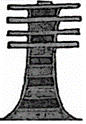
The Djed Column has multiple interpretations. Some are Osiris’ backbone and a Cedar Tree (again the tree motif). Indeed, it is curious that E. Douglas Clark ties Abraham with the symbol of a cedar.[Astronomy, Papyrus And Covenant, chapter 3] Of course, it is in the myth of Osiris where Osiris in his sarcophagus morphed because it was enclosed into a tamarisk tree, which was subsequently set up as a pillar in the palace of the gods.[Primitive Mythology: The Masks of God, pp.424-425] In the geocentric description of the North Star as the nail in the sure place in Isaiah 22, in Hebrew the word sure here is aman, which is a root meaning to build up, or to support, that which is sure or faithful as an adjective, and the term omenah is a column or pillar. And not surprisingly, amanah, from the same root is “covenant,” or “something fixed.” And of course, Christ is the Amen, the true and faithful witness.[Revelation 3:14] Once again, it is the central pillar, the Nail of Heaven. But in the center of the hypocephalus of Facsimile #2, Nibley tells us it is Amun/Ammon, in his aspect as the creator god Khnum. Again, all things have their likeness.
The bone is the symbol of regeneration and renewal to the Native Americans, just as Osiris and his backbone are symbols of resurrection and renewal to the Egyptians. As Joseph Campbell describes from Shamanic myth, it is a “particle of bone” that makes possible the “dead man’s return to life… just as he had been before” so that he doesn’t degenerate into some other form. The bone “does not disintegrate into something else, but is the undestroyed base from which the same individual… becomes magically reconstructed, to pick up life where he left it.”[Primitive Mythology: The Masks of God, p. 291]
In Facsimile #1 in the Book of Abraham, Abraham himself is on the Lion Couch, but the Egyptological interpretation of the figure of Abraham is Osiris. So Osiris stands for Abraham, or is a substitution, or proxy or surrogate. In ancient Egypt, the Djed was the symbol of enduring, stability and regenerative power in ancient Egypt. Faulkner interprets it as resembling a tree trunk with cut-off branches. But what is really amazing is how it resembles some kind of ladder, or perhaps a stairway.
In some ancient illustrations, the Osiris-Djed has two serpents coming out from underneath him. Serpents are connected to the ecliptic, and the word for serpent is djed-ft, obviously connected to Djed. So as you can see, there is a connection between the Caduceus, the symbol of modern medicine, and the djed symbol of the ancient Egyptians. The common elements of the two symbols are the serpents facing one another, as well as the rod or pillar in the middle. The djed was, as it were, a tree that links the earth and stars. Here is a representation of the Caduceus:
Malachi calls Christ the Son of Righteousness with healing in his wings. [Malachi 4:2] And, of course, Moses lifted the serpent on the pole in the wilderness.[Alma 33:19; Numbers 21:9] Now, compare this also with ancient Chinese symbols including Fu Xi and Nu Kua, a pair of Chinese deities, which were depicted as if their lower bodies were two intertwined serpents, just like the Caduceus. Clearly, the fact that it is the lower bodies being entwined is very suggestive of procreative activity. Also, notice how one is holding a compass, and the other a square:
This same thing was found in ancient India. They called their serpent like dragons “naga.”
Campbell writes that the “well known serpent-daemon (naga) motif that plays such a conspicuous role in… Indian religion… evolved—no doubt from the primitive theme of the monster-serpent of the abyss.” And then he reminds us of the grand cosmic serpent in the cosmic waters of the sea of milk.[Primitive Mythology: The Masks of God, p. 435-436] Not only does this return us to Typhon and is thigh, but also to Leviathan, who was the grand nemesis of Yahweh (Jehovah) in the myth referred to in Job and Isaiah:
In that day the Lord with his sore and great and strong sword shall punish leviathan the piercing serpent, even leviathan that crooked serpent; and he shall slay the dragon that is in the sea.[Isaiah 27:1]
This is not the sea, but the sea of milk, the cosmic sea. “Canst thou draw out leviathan with an hook? or his tongue with a cord which thou lettest down? Canst thou put an hook into his nose? or bore his jaw through with a thorn?”[Job 41:1-2] This is the constellation draco, that captured the third of the stars of heaven in his tail.[Revelations 12:3-4] And he battles eternally with Ursa Major, the Great Bear or Bull constellation in the heavens, and wounds his thigh, as the one constellation is right next to the other. Yahweh is Ursa Major in the Hebrew myth.
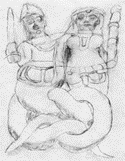
The nagas of India in the fashion above not only form a symbol that looks like the “infinity” symbol that we are used to in our culture. But this is also the exact fashion of the so-called “love knot,” otherwise known as the “wedding knot,” “reef knot” or, in Roman Lore, the “Hercules knot,” symbolizing the legendary fertility of Hercules. “Handfasting” was the fastening of the hands in a knot with rope or something else like a strip of cloth or a ribbon in marriage ceremonies in medieval times is associated with the Hercules knot. Eastern Orthodox churches still do this in marriage ceremonies. There is a clear association with intertwining and knots in the tradition of handfasting.
The nagas were considered alchemical symbols of transformation from lower to higher levels, or the link between the earth and the heavens. It has become clear from all of this evidence that that the intertwining curves of the snakes in the Caduceus is the analog to the ribs in the rib cage. The Hebrew word pathil means twine, and pathal means to twine or to struggle, which brings to mind the wrestle with God that Jacob had. Pethen means to twist. Shazar means to twist. Shor means an umbilical, or a string as twisted. Indeed, this word pathal, similar to the word pethen, meaning asp, is used in the book of Genesis to mean a struggle or a wrestle: “And Rachel said, With great wrestlings have I wrestled with my sister, and I have prevailed: and she called his name Naphtali.”[Genesis 30:8] The name Naphtali is from that word.
Also, in India, we encounter the Vedic god Aja Ekapad, symbolizing the Sun and the Day Star. The name of this god has two parts: Aja, meaning alternately “goat,” or “unborn,” and Ekapad, meaning uniped, or one-footed (Eka, meaning one, and pad, meaning foot). He is called the “supporter of the sky.” Furthermore:
He combines in himself the associations that go with the sacrificial pole, Indra’s spear, the axis of the world, the creation of the universe, and the double-meaning of the word aja as the unborn source of the world and a sacrificial animal… This is reminiscent of Indra’s spear propping up heaven… and it points to a further association of the image with the axis mundi which goes right through the whole creation as a connecting route between heaven and earth…[Werner, Karel, A Popular Dictionary of Hinduism, p. 26]
Some traditions maintain Aja Ekapad is a snake (the serpent of the deep) rather than a goat, and thus a uniped, in the form of a naga. He is “unborn,” or in other words, “uncreated,” being a symbol of chaotic matter without order. Although, not received with very much applause or consideration, H. Brunnhofer associated the goat uniped with the polestar. Whatever the case, one observation is that, “Instead of being the polar star, the one-legged billy-goat might be a neighboring constellation, and consequently nearly stationary.”[Dumezil, Georges, Les Dieux des Germains, pp. 147-148] So clearly, it is the opinion of some that there is something circum-polar going on here, at the very least, and that the uniped idea is linked to the axis mundi, because of its stationary nature, being an omphalos. From a strictly Hindu interpretation, it is hard to link Aja Ekapad to the polestar directly. But in conjunction with Chinese data, and from other parts of the world also, the connection becomes much clearer.
In the case of the mythical deities Nu Kua and her husband/brother Fu Xi, a pair of uniped Chinese gods, it is the sacred embrace lawfully between husband and wife, the Hieros Gamos, or sacred marriage, described by Eugene Seaich in his masterful volume, A Great Mystery. Levenda describes the Hieros Gamos as taking place on the top of Babylonian Ziggurats, after the participants had ascended thereto.[Stairway To Heaven, p. 25] It is the symbol of the welding of the generations, the turning of the hearts of the children to the fathers and vice versa. Eugene Seaich comments on the Astana veil which depicts Fu Xi and Nu Kua. He says that these two characters “represented the Cosmic Mountain that supports the sky” and that they were also associated very closely “with the Great Bear [i.e. the Dipper]” as it rotates around the pole star. He notes that these two characters are, most of the time “shown resting upon a single foot, or tail,” and mentions that this is probably the reason that “a limping dance has been an important part of their worship, designed, as it would seem, to produce thunder and rain.” He calls Fu Xi “best known of all these ‘unipeds.'” He says that from about 2000 years ago, these two have “intertwining tails, depicting a creative embrace,” linking them to the idea of the “Indian nagakals (intertwining serpent deities), whose own form was derived from the Sumero-Babylonian caduceus.”[A Great Mystery: The Secret Of The Jerusalem Temple, The Embracing Cherubim and At-One-Ment with the Divine, p. 381]
Fu Xi and Nu Kua were husband and wife, but also brother and sister, precisely as Osiris and Isis in Egypt. They were to China what Adam and Eve is to the Judeo-Christian tradition, the first man and first woman.
It is, of course, no coincidence that we are told that Jacob “halted upon his thigh.” [Genesis 32:21] You see, to halt is to limp. And, as we have already observed, of course, the thigh is the Dipper, once again. Levenda describes the Limping Dance as the Chinese “Pace of Yu,” a circumambulation, and that it is identified with the “seven stars of the Dipper.” He describes it as what happens when one tries to go “in a straight line with a limp or with one leg shorter than the other,” and naturally one’s path “becomes a circle, describing a circumference around a central point.” And then he astutely observes that it is the very same thing that the “stars of the Dipper do around the Pole Star…” And then he ties that to the Egyptian idea of the “Thigh of Set” where anyone or any animal that is “wounded in one leg or deprived of one leg, would limp.”[Stairway To Heaven, p. 123]
The grand archetype for the myth of the wounded leg comes from the Messiah himself. “And I will put enmity between thee and the woman, and between thy seed and her seed; it shall bruise thy head, and thou shalt bruise his heel.”[Genesis 3:15] It is Satan, the serpent, who succeeds in wounding the Savior in his crucifixion, yet, in the end, Satan shall be crushed. Indeed, in the in the Targum Onkelos, it contains a commentary on this verse, known as the “The Heels (or footsteps) of the Messiah,” saying “He will remember what you did to him in the beginning, and you shall be observing him in the end,” referring to a round course, the eternal round.[http://mahood.wordpress.com/category/nearmiddle-east-mythology/biblical-mythology/] Joseph Smith, interestingly enough, is another incarnation of this same archetype. Joseph Smith, when he was very young, had typhoid fever. And though he got over it, it appears that his body was weakened and susceptible to infection, perhaps. Whatever the case, an infection worked its way into his leg, and it had to be operated on. Several parts of the bone removed, without anesthetic. This left him somewhat lame afterward for many years. Reportedly he walked with somewhat of a limp into his later life. [Lucy Mack Smith, The History of Joseph Smith, by his Mother, p. 59-61, 65; Shanna Butler, “Playing Joseph Smith,” New Era, November 2005, p. 24] He is the ritual embodiment of the wounded leg theme, and the Lord actually played out that ritual theme in history, a concept we have spoken of elsewhere.
The translation in the targum is actually exegetical. Head is rosh, or “the beginning,” as in beresheit, the first word in the first verse of the Bible.[Strongs Exhaustive Concordance, 7218] Heel is eqeb or aqeb, which also figuratively means “the last of anything,” or the “result,” but it is also the “track” on which one treads or the “step” one takes.[Strongs Exhaustive Concordance, 6118, 8119] Thus, the Savior himself treads the course of the wounded “thigh,” until he overcomes all things. This is the oroboros, the two serpents eating one another’s tails in an eternal dance. The Savior is the Beginning and the End, the Alpha and the Omega, the Alfa and the Tav, the Alpha being the Bull, and the Tav, or Tau, or Taurus, being the Bull, the two Bulls. Khonsu is the beginning and the ending for the Egyptians, and is the manifestation of the two Bulls. In Nordic mythology, Iormungand is the World Serpent who lies in the sea surrounding Midgard, her tail gripped in her own mouth. Thor, after crushing the head of the serpent, was overwhelmed by the serpent’s venom, yet he was able to take nine steps backwards before dying.
The scriptures say: “And Abraham said unto his eldest servant of his house, that ruled over all that he had, Put, I pray thee, thy hand under my thigh.”[Genesis 24:2] The translation of this verse in the Joseph Smith Translation translates “thigh” as “hand,” or, literally, handclasp. It wasn’t a mistranslation. It was Joseph Smith’s exegetical translation of the word thigh, because both translations are correct, both from Joseph Smith and from the King James Version. As we saw, Isaiah 22:23 is geocentrically is tied to the North Star. In that verse, the term “fasten him” (the verb taqa) is “to drive (a nail or tent-pin, a dart, etc.)” or “to become bondsman (by handclasping).”[Strongs Exhaustive Concordance, number 8628] For it is the Dipper, or Thigh, that circumambulates around the North Star in the circum-polar region. We read that the “hollow of Jacob’s thigh was out of joint, as he wrestled with him.”[Genesis 32:25] The “out of joint” phrase, or yaqa is figuratively “to impale.”[Strongs Exhaustive Concordance, number 3363] And it sure sounds similar to the word taqa, as they rhyme. We can discern here that the symbol of the Dipper is intimately tied with handclasps, as is the North Star, as the Dipper. Dipper, or Thigh, is the substitution for handclasp, because of the ritualistic connections between the two. It is not quite a metonymy, but comes close. It is a struggle to describe this. There isn’t a precise word for this type of ritual substitution in this case, but it is a metaphorical substitution. A good example in the scriptures of a substitution such as this that is more commonly known is Zion as a symbol of Jerusalem. Zion has since come to take on additional meanings over time, including the New Jerusalem and Nauvoo, and even Salt Lake City or Utah. But early on, it was synonymous with Jerusalem, because it was the name of a mountain (Mount Zion) there in Jerusalem, so in this case, it is more of a synecdoche, or metonym.
The Hebrew word abaq means to wrestle, or to embrace, Of course, the word-play with this one and the word “heel” is immediately apparent, as heel is aqeb. This is an instance of phonetic reversal. Hugh Nibley discussed the very “puzzling episode” from the scriptures about Jacob wrestling with God. He points out that the word “conventionally translated by ‘wrestled’ (ye’aveq) can just as well mean ’embrace,'” and it was in the “ritual embrace that Jacob received a new name and the bestowal of priestly and kingly power at sunrise…” And he links it to the “Egyptian coronation embrace…”[Message of the Joseph Smith Papyri, 2nd Edition, p. 434] But as a noun, abaq means dust, just as in the creation of Adam, Adam is created from dust in the sacred embrace of Hieros Gamos.
Hollow is kaph, “the hollow hand or palm (so of the paw of an animal, of the sole, and even of the bowl of a dish or sling, the handle of a bolt, the leaves of a palm-tree.” And even, figuratively, “power.”[Strongs Exhaustive Concordance, 3709] Anciently, palm trees were symbols of overcoming or prevailing, bringing to mind the Savior’s triumphant entry into Jerusalem. From the Encyclopedia of Freemasonry, mention is made of the so-called “Lion’s Paw” used in that fraternity. They say that it is a “mode of recognition so called because of the rude resemblance made by the hand and fingers to the lion’s paw. It refers to the Lion of the Tribe of Judah.”[Encyclopedia of Freemasonry, by Albert Gallatin Mackey, Robert Ingham Clegg, Harry LeRoy Haywood, p. 596] And they point out that there are two scriptures that this idea is partly derived from in the Bible. Firstly, in the scriptures, we see this:
David said moreover, The Lord that delivered me out of the paw of the lion, and out of the paw of the bear, he will deliver me out of the hand of this Philistine. And Saul said unto David, Go, and the Lord be with thee.[1 Samuel 17:37]
And then, secondly, in Revelation:
And one of the elders saith unto me, Weep not: behold, the Lion of the tribe of Juda, the Root of David, hath prevailed to open the book, and to loose the seven seals thereof.[Revelations 5:5]
And once again, back to Jacob’s “wrestling,” we notice that it was Jacob that prevailed when he was crowned with power in the “wrestling” with the “angel.” Of course, in David’s prophecy of the words of Christ on the cross, we read:
My God, my God, why hast thou forsaken me? why art thou so far from helping me, and from the words of my roaring?[Psalm 22:1]
Christ is the Millennial Davidic King:
Men and brethren, let me freely speak unto you of the patriarch David, that he is both dead and buried, and his sepulchre is with us unto this day. Therefore being a prophet, and knowing that God had sworn with an oath to him, that of the fruit of his loins, according to the flesh, he would raise up Christ to sit on his throne…[Acts 2:29-30]
So David (at least during the righteous part of his life) was a type of Jesus Christ. From the Ethiopic Enoch 24:3-6;25:1-6, we see all of these archaeo-astronomical connections once again. Ethiopic Enoch mentions the “seventh mountain” in the vision. It resembled “the seat of a throne…” This once again takes us back to Facsimile #2 in the Book of Abraham, where the central figure, identified by Joseph Smith as “Kolob” is a mirror-image seated figure that resembles a mountain. It is a god on a throne, namely Khnum-Ra or Amen-Ra, the ram-headed god of creation. And around this mountain or throne, “fragrant trees encircled” it. There is the circumambulation, around an omphalos. Now we get to the meat where the djed column or tree comes in. Because among these trees, there was “a tree such as I had never yet smelt, neither was any amongst them nor were others like it…” Just as with Lehi’s tree of life, “its fruit is beautiful,” yet its “fruit resembles the dates of a palm.” Then Enoch inquires of the angels about the tree, and about the other things in the vision such as the mountain. Michael the archangel explains that the summit of the mountain “whose summit is like the throne of God, is His throne…” Then Enoch is told that the tree will be moved to the “holy place, to the temple of the Lord,” showing the link to the trees in Eden, but also to the “seven objects in the Holy of Holies” spoken of previously by Eugene Seaich. Then after this, a poem is recited to Enoch, where it says that the faithful will enter “into the holy place…” The tree’s “fragrance shall be in their bones, and they shall live a long life on earth…” This is another link to the djed pillar again, not only because of the tree, but because of the ankh-djed-was formula that we can discern here. It is the “ankh” (life) symbol, the “djed” (backbone) column symbol, and the “was” (authority) symbol, that occur together sometimes in Egyptian formulas. Cottle says that this formula refers to the blessing of “having all power, all life, and all stability.”[Thomas D. Cottle, The Papyri of Abraham: Facsimiles of the Everlasting Covenant, p. 103] Similarly, in the Egyptian in Facsimile #2 of the Book of Abraham, in figure 8, the text refers to a plea from the Osiris Sheshonq that the God of the Universe grant to him life, represented by the ankh symbol. Since the ank-djed-was is directly connected to the mysteries of godliness, it is only natural that Joseph Smith wrote that figure 8 of the hypocephalus “Contains writings that cannot be revealed unto the world; but is to be had in the Holy Temple of God.” There also seems to be a connection between this formula and the Three Immortals of China. Many Asian businesses seem to display the statuettes of three immortals. They symbolize, once again, all good gifts: happiness, prosperity and longevity.
The Light of Christ in One’s Countenance and Priesthood Power
Referring to this idea, Parley P. Pratt wrote:
An intelligent being, in the image of God, possesses every organ, attribute, sense, sympathy, [and] affection… possessed by God himself… The gift of the Holy Spirit adapts itself to all these organs or attributes… It inspires, develops and matures… our nature… It strengthens, invigorates and gives tone to the nerves. In short, it is, as it were, marrow to the bone, joy to the heart, light to the eyes, music to the ears, and life to the whole being.
In the presence of such persons one feels to enjoy the light of their countenances, as the genial rays of a sunbeam. [Key to the Science of Theology, pp.101-102]
Indeed, as one of our hymns states, “Truth reflects upon our senses; Gospel light reveals to some.”[Hymn 273] Or, as stated another way in the Doctrine and Covenants:
For whoso is faithful unto the obtaining these two priesthoods of which I have spoken, and the magnifying their calling, are sanctified by the Spirit unto the renewing of their bodies. [D&C 84: 33]
Another instance in the scriptures of the ank-djed-was formula is in Proverbs, followed up with the theme of renewal and the promise of increase:
Be not wise in thine own eyes: fear the Lord, and depart from evil. It shall be health to thy navel, and marrow to thy bones. Honour the Lord with thy substance, and with the firstfruits of all thine increase: So shall thy barns be filled with plenty, and thy presses shall burst out with new wine.[Proverbs 3:7-10]
Some scholars have noted a connection between Egyptian writings and the Proverbs, such as the fact that Proverbs 22:17-24 has a direct connection to the Instructions of Amenhotep. It should come as no surprise that the ank-djed-was formula also appears in Hebrew literature. This is clearly a blessing of the priesthood since it is linked to the oath and covenant of the priesthood in D&C 84. Similarly, the connection to the wording in the Word of Wisdom in the Doctrine and Covenants is immediately apparent, as that is the Lord’s law of health.
Spiritual Darkness in One’s Countenance and Priesthood Curses
These promises of increase and renewal and health are in stark contrast to the promised destruction and lack of prosperity promised to the servants of Satan, who follow after the pattern of Cain. Just like Cain was promised that the earth would not yield her strength, to these people, the promise is that…
their hope shall be blasted, and their prospects shall melt away as the hoar frost melteth before the burning rays of the rising sun… That they may be disappointed also, and their hopes may be cut off… they shall be severed from the ordinances of mine house. Their basket shall not be full, their houses and their barns shall perish, and they themselves shall be despised by those that flattered them. They shall not have right to the priesthood, nor their posterity after them from generation to generation.[D&C 121:11-21]
Here, a priesthood curse is pronounced, that would be exacted on both the offender as well as his posterity, that they would be severed from the ordinances of the Temple and not have the right to priesthood. At one point Orson Hyde had apostatized, but then he later repented:
I was on my return from Richmond,… and on the wide prairie I saw a man walking behind me. I reined in the team to let him overtake me, and who should it be but Orson Hyde, who had apostatized in the fuss, but had seen a vision in which it was made known to him that if he did not make immediate restitution to the Quorum of the Twelve, he would be cut off and all his posterity, and that the curse of Cain would be upon him… I saw that Brother Hyde was on the stool of repentance, and he did repent good and got back to his place in the Twelve.[Journal of Hosea Stout]
So, the Curse of Cain is not a mythological, nonsensical priesthood curse that comes upon people of a certain race as in the folklore versions of the doctrine. Actually, in a scriptural understanding of real priesthood curses, there is actual logic and reasoning. A curse comes upon the unrighteous and the effects are felt upon their posterity because of their own rebelliousness, and, while their posterity is affected adversely, it is not like somehow they are cursed with something that cannot be overcome. Their posterity is only “cursed” with the curse so long as they do not turn back to the Lord. The darkness that comes upon people is manifest as a lack of the light of the Spirit in their eyes. Their countenance no longer shines.[Alma 5:14; 3 Nephi 13:22-23] The sins are upon the heads of the parents, not upon the children.[2 Nephi 4:6; Moses 6:54; D&C 68:25] It is only consequence of sin from the parents that is suffered by the posterity. When the posterity turns to righteousness when they are reclaimed, then the blessings return to the family line. The blessings of the righteous flow unto them in a natural way as a natural course of events because the justice of God naturally causes blessings to flow:
The Holy Ghost shall be thy constant companion, and thy scepter an unchanging scepter of righteousness and truth; and thy dominion shall be an everlasting dominion, and without compulsory means it shall flow unto thee forever and ever.[D&C 121:46]
The term “sons of perdition” in the classic sense means those who blaspheme against the Holy Ghost. These are they who altogether turn away from the Priesthood Covenant:
Therefore, all those who receive the priesthood, receive this oath and covenant of my Father, which he cannot break, neither can it be moved. But whoso breaketh this covenant after he hath received it, and altogether turneth therefrom, shall not have forgiveness of sins in this world nor in the world to come.[D&C 84:40-41]
It is true that a regular apostate isn’t necessarily a son of perdition (in the usual way the phrase is understood), if he did not have a great amount of light to turn away from. But still, the Curse of Cain is what comes upon all apostates, whether they have denied the Holy Ghost or not. It is the same curse and spirit upon him (but to a lesser degree). He has still turned away from whatever amount of light he had, and is now in darkness. He has still broken the covenants he made, and becomes “posterity of Satan” even if in the end he will be redeemed to some state of glory.[Alma 24:30]
More on Jacob’s Wrestling
Now, we go back to our discussion on Jacob’s “wrestling.” The “halting” or tsela in Hebrew is to “limp,” or the act of circumambulation as a verb, but as a noun, it is also the rib, from whence Eve was taken, for it is that very word in that is used in the Genesis account of Eve’s creation. It is the Djed, the Rib, the Dust, the product of the Heiros Gamos, or sacred embrace. The Rib or tsela is the “side,” just as the yarek is the side. The Hebrew word for “thigh” in this case is yarek, which is closely related to the word tsela, not by the sound of the word, but by the meaning and the connections we have shown previously, showing the generative connection here. Again for further elaboration on this theme, I refer you to the chapter on Adam’s creation.
“Shrank,” in the account of Jacob’s wrestling is Nasheh, meaning rheumatic or crippled, from the root Nashah, meaning to forget or to neglect, but another form of the root means to lend or borrow. Now, an almost identical related term is Nashak, which is a root meaning to strike, or to oppress with taxation or usury. Neshek is interest that you pay, so this is intimately tied with Nasheh. But the clincher is the root Nasaq, to catch fire, or Nesheq, to fasten up, to kiss, or, figuratively, to touch.
All the brethren greet you. Greet ye one another with an holy kiss. The salutation of me Paul with mine own hand.[1 Corinthians 16:20-21]
All of these meanings are related to the meanings of paqa or taqa, to fasten, to strike, etc. The word use is an intentional word-play. The use of the meaning crippled or shrank once again ties again with the circumambulation of the so-called “unipeds.”
Seven days shalt thou keep a solemn feast unto the Lord thy God in the place which the Lord shall choose: because the Lord thy God shall bless thee in all thine increase, and in all the works of thine hands, therefore thou shalt surely rejoice.[Deuteronomy 26:25]
The solemn feast here in this scripture is chagag, “to move in a circle, i.e. to march in sacred procession, to observe a festival.”[Strongs Exhaustive Concordance, 2287]
Let them praise his name in the dance: let them sing praises unto him with the timbrel and harp.[Psalm 149:3]
Dance here is machowl, “a round dance” from chuwl, “to twist or whirl (in circular or spiral manner)” or “to dance.” Note that they are “praising his name” in the dance or circle. Nibley writes that “Lucian’s famous essay on the ancient dance” is related to the “round dance in the temple,” which Nibley relates to the ancient Christian prayer circle. And he says that some “referred to this as a dance; it is definitely a chorus.”[Temple and Cosmos, p. 22]
The Hopi and other Indian tribes have the ancient symbol of the Nakwach spiral, which is the curled sprouting bean. It symbolizes life, rebirth, and brotherhood, and also the destination of a long journey. It is also a Hopi handclasp to be done during a special dance during the ceremony called the Wuwuchim, something, incidentally, that fascinated Hugh Nibley as well. It marks the start of the year, and young men are ceremonially initiated into societies. Here are some representations of the Nakwach symbol:


One cannot help but to notice these spiral patterns all over nature, such as in the swirling pattern manifested in the spiral arms of a galaxy. And so now, we come full circle. Nibley tells us that in the Dead Sea Scrolls, in the document called the “Manual of Discipline,” the “singer promises to gauge all his doings and mark the course of his ring-dance to the music of the spheres with the plumb-bob and line.” And, back to Nu Kua and Fu Xi, found on the “Astana veil” which Eugene Seaich spoke of. Nibley mentions that the veil on which they were drawn is “dominated by the Great Bear, indicating the center of the universe, the omphalos or umbilicus mundi, the navel of the cosmos.” And therefore, the “square, compass, and Pole-star designate the veil as the cosmic gate, curtain, or barrier to worlds beyond.”[The Early Christian Prayer Circle, http://farms.byu.edu/publications/transcripts/?id=59, emphasis added.]
[1] http://user.xmission.com/~research/central/resth3a.htm
[2] Abraham 5:7, 15-16
[3] Abraham 1:28
[4] Church News, October 9, 1976
[5] Genesis 2:7
[6] Genesis 2:21-25
[7] Of Souls, Symbols, and Sacraments, p. 152-167
[8] The Promised Messiah, p. 62
[9] “The Man Adam,” Ensign, Jan. 1994, p. 8
[10] Genesis 2:7
[11] Genesis 3:19
[12] Genesis 2:7
[13] Genesis 3:19
[14] Echoes of Eden, p. 21
[15] See Thomas V. Gamkrelidze, and V. V. Ivanov, The Early History of Indo-European Languages, http://www.biblemysteries.com/library/indoeuropean.htm; http://www.myetymology.com/proto-indo-european/dheghom-.html
[16] Alma 40:11
[17] Reik, Theodor, The Re-emerging Mother-Goddess (from Pagan Rites in Judaism), https://magdelene.wordpress.com/2009/04/24/the-re-emerging-mother-goddess/amp/
[18] Beaulieu, Stéphane, Eve’s Ritual: The Judahite Sacred Marriage Rite, pp. 206-207, https://www.academia.edu/32203467/Eves_Ritual_the_Judahite_Sacred_Marriage_Rite
[19] http://www.biblelearn.com/east0079.htm, emphasis added
[20] Message of the Joseph Smith Papyri: An Egyptian Endowment, second edition p. 489. The first edition of Nibley’s book contained the wording “word-play” and the second edition has this language editorially clarified a bit, with the phrase word-play dropped for some reason. I think the original phrase was more precise than just calling it a “coincidence.” But John Gee and the other editors of the Second Edition would have to explain their reasoning for the change. Calling it a coincidence seems to imply a claim that it was at least accident without committing to the conclusion that the original author intended it that way, whereas calling it a word-play seems to imply something deliberate. I say it is deliberate.
[21] http://www.newadvent.org/cathen/06592a.htm, emphasis added
[22] Proverbs 1:20
[23] Joseph Campbell, Primitive Mythology: The Masks of God, pp. 388-389, emphasis added
[24] FARMS Review 2007, Volume 1, “Does God Have A Wife?” by Alyson Skabelund Von Feldt
[25] Genesis 2:21-25
[26] Message of the Joseph Smith Papyri, 2nd Edition, p. 434
[27] Strongs 79, 80
[28] Genesis 13:15-16; see also Genesis 28:13-14
[29] Numbers 23:10
[30] Moses 6: 59
[31] Andersen, Johannes C., Myths of the Polynesians, p. 407, emphasis added
[32] Genesis 2:7
[33] Genesis 3:19
[34] Marvelous Work and a Wonder, p. 290
[35] Dee, Johnathan, Chronicles of Ancient Egypt, p. 35
[36] http://www.touregypt.net/featurestories/min.htm
[37] Joseph Campbell, Creative Mythology: The Masks of God, p. 385
[38] ibid., p. 469
[39] Genesis 2:21-25
[40] Man’s Relationship to Deity, pp. 279-280
[41] Genesis 2:21-25
[42] Strongs 259
[43] Strongs 6763
[44] Strongs 2233
[45] Strong’s 5462
[46] Strongs 1319, 1329
[47] http://www.dictionary.com
[48] Strongs 8478, 8430
[49] Strongs 8482
[50] Strongs 2004, 2007
[51] The Classical Journal, For March and June, 1819, Volume 19, London, emphasis in original
[52] Psalm 139:13-15
[53] Strongs 776
[54] Gerard P Luttikhuizen, Gnostic Revisions of Genesis Stories And Early Jesus Traditions, p. 69
[55] see Jeremiah 7:18, 44:17-19, 25
[56] Watson, Elden J. ed. Brigham Young Addresses, Volume 2, 19 Feb. 1853.
[57] Genesis 2:21-25
[58] As recorded in the L. John Nuttall Journal, entry for February 7, 1877, http://en.fairmormon.org/Mormonism_and_temples/Endowment/Adam-God_and_the_%22Lecture_at_the_Veil%22
[59] Charles Walker Journal, June 11, 1892
[60] Sermons and Writings of Bruce R. McConkie, p. 199.
[61] http://mrm.org/bruce-mcconkies-rebuke-of-eugene-england
[62] http://www.eldenwatson.net/7AdamGod.htm
[63] Alma 11:45, see also D&C 138:17
[64] As recorded in the John L. Nuttall Journal
[65] http://en.fairmormon.org/Adam-God_and_the_%22Lecture_at_the_Veil%22
[66] ibid.
[67]Journal of Discourses 10:355; November 6, 1864
[68] October 8th, 1861 discourse
[69] http://www.ldshistory.net/adam-god/ag5.html
[70] D&C 77:6
[71] 1 Nephi 15:32-32; 2 Nephi 2:21; D&C 29:43
[72] Abraham 5:13
[73] Incidentally, Phelps was one of the scribes who worked on the Kirtland Egyptian Papers
[74] N. B. Lundwall, Temples of the Most High, Sixth Edition, p. 246, quoting from Times and Seasons, Vol. 5, pp. 757-61.
[75] see for example http://chriscarrollsmith.blogspot.com/2008/06/w-w-phelps-on-age-of-earth.html
[76] Yang, Lihui; An, Deming; Turner, Jessica Anderson, Handbook of Chinese Mythology, p. 76)
[77] Hunt, Norman Bancroft, Shamanism in North America, p. 37
[78] “Scripture as Incarnation,” Historicity and the Latter-day Saint Scriptures, p. 52, note 13
[79] D&C 132:20
